


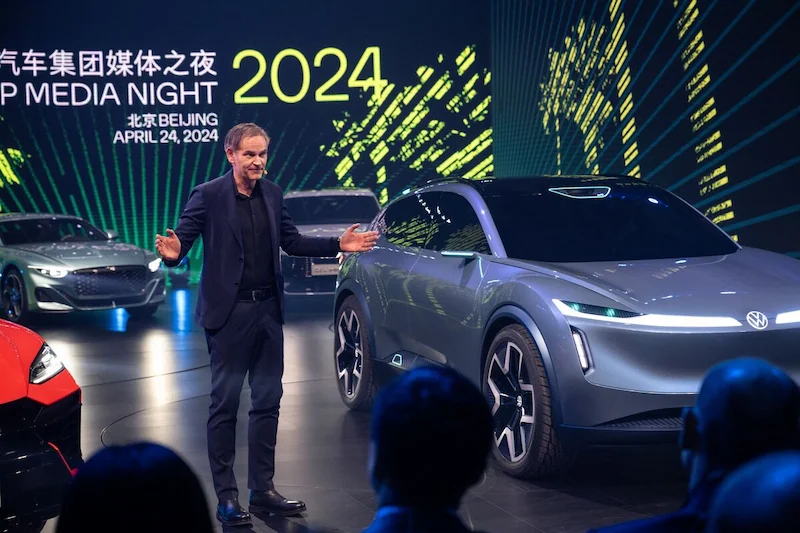


Volkswagen AG is making significant adjustments to its electric vehicle (EV) strategy, signaling a shift away from its previous "all-in" commitment to EVs. The VW brand, which had positioned its ID family of EVs as the cornerstone of its future, recently acknowledged the need for more plug-in hybrid models as EV sales slow down. This move comes in response to several setbacks the company has faced, including model release failures and falling behind in the Chinese market, where domestic brands now dominate. As a result, VW has abandoned plans to seek outside investors for its battery unit and has canceled a €2 billion ($2.2 billion) EV factory in Germany.
Interestingly, VW currently sells a substantial number of vehicles with combustion engines, and there is a possibility that the company may exceed its emissions allowance next year. CEO Oliver Blume has even requested leniency from European regulators. This situation is a stark contrast to just three years ago when VW was aggressively advocating for EVs in the European Union, causing tension with some of its peers in the industry.
Previously, VW had no other choice but to emphasize its electrification strategy following the fallout from the "clean" diesel scandal. The company's reputation took a hit when it was discovered that VW had cheated on emissions tests, leading to a sudden shift towards battery-powered vehicles. In 2019, then-CEO Herbert Diess announced plans to launch up to 75 all-electric models over the next decade, adopting an EV-or-bust approach. However, this strategy did not sit well with other car manufacturers who wanted more time and flexibility to transition away from combustion engines.
While VW is recalibrating its approach, it has not completely abandoned electric cars. Blume is forming partnerships with companies like Xpeng Inc. and is in the process of establishing a new EV brand in China. Their aim is to win back young consumers who have drifted towards BYD Co. and Tesla Inc., offering technologically advanced models. Furthermore, VW is engaged in discussions with European counterparts, such as Renault SA, to develop more affordable EV options for mass-market car buyers.
VW is not the only company facing challenges due to the slowdown in EV sales. Countries like Germany and Sweden have reduced or eliminated subsidies for EVs, which tend to be more expensive than their combustion counterparts. This has had a negative impact on the overall EV sector. Insufficient public charging infrastructure has also discouraged potential EV buyers.
Other car manufacturers, such as Stellantis NV and Mercedes-Benz Group AG, are also adjusting their strategies in response to the slowdown in EV demand. Stellantis aims to lower the cost of its EV offerings by selling cars co-developed with a Chinese partner in Europe. Mercedes-Benz has halted the development of underpinnings for new electric luxury sedans to save costs and plans to continue selling gasoline-powered cars for longer than initially anticipated. BMW AG, which has experienced some success in selling EVs compared to its German competitors, recently warned that the EU's plan to effectively ban new combustion-engine vehicle sales by 2035 will harm the industry. European regulators are scheduled to review this policy in 2026.
Even Tesla, the industry leader in EVs, has been impacted by the deceleration in EV adoption. The company has experienced a decline in market capitalization of $235 billion this year, which is more than three times the current valuation of VW. Nonetheless, Tesla CEO Elon Musk has criticized other carmakers for scaling back on EVs and shifting focus to plug-in hybrids. Musk maintains that EVs will ultimately dominate the market.
In summary, Volkswagen AG is implementing significant adjustments to its electrification strategy as EV sales slow down. While the company is shifting focus towards plug-in hybrids, it has not completely abandoned electric cars. VW is exploring partnerships, establishing a new EV brand in China, and seeking collaborations to develop more affordable EV options. The slowdown in EV demand has affected other car manufacturers as well, forcing them to recalibrate their strategies. The future of EVs remains uncertain, but the industry continues to navigate this evolving landscape.