


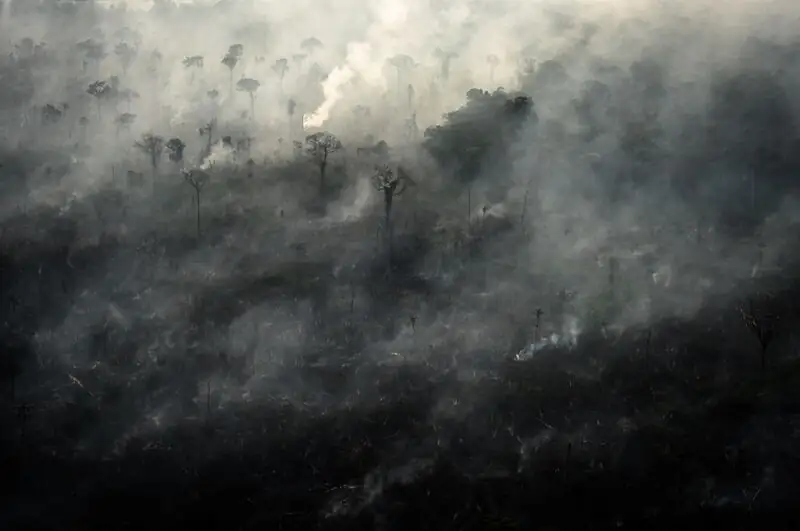


A team of Earth scientists introduced the concept of “planetary boundaries” almost 15 years ago to identify major Earth systems at risk of instability due to human activity. These “planetary boundaries” include systems like climate, biodiversity, and fresh water. The scientists determined the limits of what they called a “safe operating space” for civilization. Their work showed that humanity had already surpassed seven of the eight global boundaries. However, their work did not fully analyze how exceeding these limits might impact people, especially the poor and vulnerable.
In a major update published in the journal Nature, researchers examine how the violation of planetary boundaries can harm people. The study examines levels of risk to humans and ecosystems to determine how much punishment nature can absorb before turning on us. This new analysis also includes criteria for justice impacting the millions of people at risk today, the billions coming in the future, and the world’s countless species and ecosystems.
For some Earth systems, like the climate, the fairness analysis requires more stringent limits than geophysical-stability factors would dictate. The warming limit of 1.5C enshrined in the Paris Agreement has already been surpassed as shown by the tens of millions of people now exposed to dangerous heat. By 1.5C, the scientists find that more than 200 million poor, vulnerable, and marginalized people can expect to encounter unprecedented heat. The targeted global warming limit is below 1C, but countries will still inevitably need to address the consequences. The authors call for international compensation to help poorer countries cope with climate-related loss and damage following last year’s UN climate talks.
This study calls for a massive global transformation across all Earth system boundaries to ensure human well-being. The authors point out that this requires a genuine understanding of justice, economics, technology, and global cooperation in the service of a safe and just future. The paper strives to quantify the planet-scale changes that are driven mostly by social and economic systems run on unsustainable resource extraction and consumption.
The new work builds on previous planetary-boundaries research, including other assessments of social vulnerability to systemic change like the UN Sustainable Development Goals. The authors make a breakthrough in this paper by translating social justice considerations into the same units of measurement as the Earth systems, such as degrees Celsius for temperature or cubic kilometers for water use.
For instance, nitrogen and phosphorus from farms spill into waterways, producing oxygen-less “dead zones” in rivers and seas. The scientists recommend that the global limit for excessive nitrogen be no more than 119 million metric tons a year, and 10 million for phosphorus, according to the paper.
To address air pollution, the scientists set targets to minimize the difference in the concentration of aerosols between the Northern and Southern Hemispheres and an upper limit for harmful small particle pollution. Aerosols from both natural and human sources cause illness and premature death around the world. They also suggest two biodiversity metrics to limit the destruction of species and ecosystems. The first metric aims to preserve 50% to 60% of natural ecosystems, higher than the current status quo of 45% to 50%. The second metric requires 20% to 25% of every square kilometer of urban, agricultural, and other land altered by humans to retain elements of natural ecosystems.
The authors are trying to achieve what has already happened for climate change to standardize practices to align with science-set thresholds. Essentially, they want to create scientific baselines that standard-setting organizations and governments can use to help companies, cities, and others ensure their operations do not contribute to further systemic environmental change or human harm. The boundaries may include, but are not the same as “tipping points,” or thresholds beyond which the planet perpetuates change with or without human input.
Johan Rockström, director of the Potsdam Institute for Climate Impact Research in Germany and co-author of this research, said the ultimate definition of justice today is the right of every human being, particularly future generations, to have a stable planet. It requires an effort to reduce sensitivity to harm and vulnerability and therefore a just global transformation across all Earth system boundaries.