


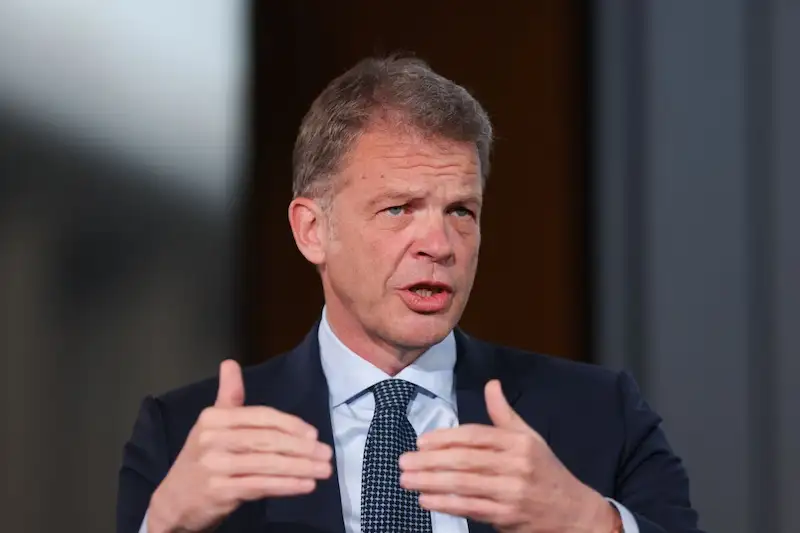


After Deutsche Bank AG reported better-than-expected revenue and profit, its Chief Executive Officer Christian Sewing expressed optimism about the bank's ability to continue increasing its revenue through next year, despite challenges from rising costs and deteriorating credit quality. Sewing highlighted that the lift from rising interest rates is holding up stronger than initially anticipated, adding that positive surprises are expected in the second half of 2023 and in 2024.
The positive remarks from Sewing helped reverse a slump in Deutsche Bank's shares, which had dropped due to a larger-than-expected increase in operating expenses caused by litigation and investments. The bank's corporate bank benefited from higher interest rates, while fixed-income traders displayed resilience in a generally sluggish business environment.
However, Sewing remains determined to boost revenue and profitability, as the bank's share price has yet to recover to the level when he assumed the role of CEO five years ago. The challenging market conditions, including a slowdown in trading, a weakening economy, and a potential waning of the lift from higher interest rates, have made it more difficult to achieve these goals, requiring a delicate balance between investments and cost reductions.
Deutsche Bank's expenses rose by 15% in the second quarter, surpassing analysts' expectations. As a result, the bank's costs for the full year are projected to increase slightly, compared to the previous guidance of flat expenses. The increase in expenses was driven by severance payments following the bank's decision to reduce senior back-office staff and litigation costs from a penalty settlement related to money laundering allegations.
In contrast to Deutsche Bank, some other banks managed to keep their expenses under control. For example, UniCredit SpA reduced costs by about 1% in the second quarter, while Lloyds Banking Group Plc maintained its full-year target for operating costs despite inflationary pressures in the UK.
Deutsche Bank's shares initially faced fluctuations, swinging between losses and gains. Since Sewing became CEO in April 2018, the bank's shares have declined by approximately 7%.
Under Sewing's leadership, Deutsche Bank has refocused on its strengths in fixed-income and corporate banking, which involved significant job cuts and an exit from equities trading. Earlier this year, Sewing surprised investors by announcing the acquisition of Numis Corp., marking his first major takeover as CEO and the bank's largest in over a decade. While the fixed-income trading business faced a decline of 10% in the second quarter, outperforming most Wall Street banks, the overall trading environment is expected to improve in the second half of the year, following the resolution of the US debt ceiling impasse.
Deutsche Bank provided a slightly more positive outlook for full-year revenue, stating that it is likely to reach the upper end of the forecast range, driven by momentum in the corporate bank. Sewing has relied on the corporate and private banks to compensate for the normalization of the trading environment. The corporate bank reported a 25% increase in revenue in the second quarter, while the private bank saw an 11% gain.
However, signs of a slowdown in the lift from higher interest rates have emerged. Demand for loans among euro zone companies experienced a record plunge in the second quarter, and Deutsche Bank also reported a drop in loans due to lower demand in its commercial banking operations. Additionally, provisions for souring debt increased by 72% compared to the previous year, indicating some deterioration in loan quality.