


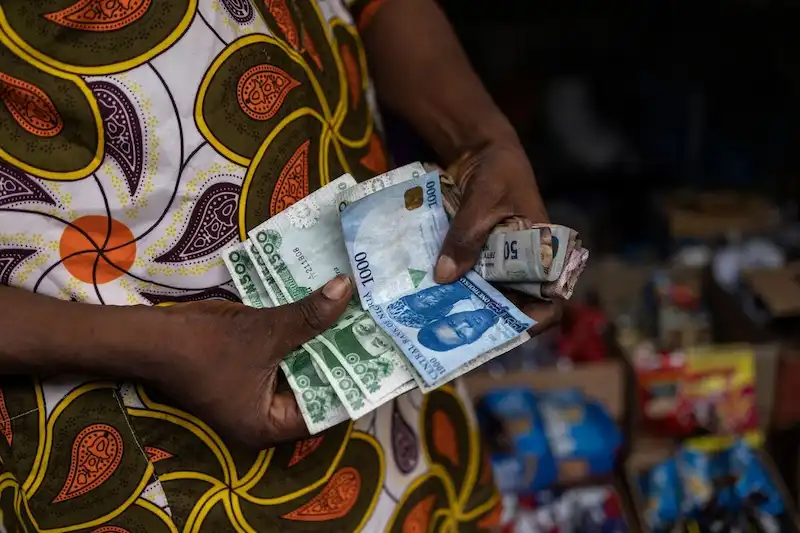


Nigeria's naira is facing a challenging situation as its essential source of support is crumbling. The country's central bank recently released its long-delayed financial statements, revealing that effective foreign exchange reserves were significantly lower than previously disclosed. The disclosed accounts showed previously undisclosed transactions of $7.5 billion with JP Morgan Chase & Co. and Goldman Sachs Group Inc., along with an exposure of nearly $7 billion in foreign currency forward contracts. Additionally, the central bank exceeded the limit on its lending to the government.
This revelation comes as the Nigerian currency has already been experiencing a decline since the central bank allowed for a more liberal exchange system in June. The issue with the lower net reserves indicated in the report further limits the central bank's capacity to defend the naira, according to Adetilewa Adebajo, CEO of Lagos-based CFG Advisory. The exchange rate on the parallel market has already reached 945 naira to the dollar, and the outlook towards 1,000 seems inevitable.
The move towards a more liberal exchange system was intended to attract foreign investors, but the expected increase in inflows has been slow to materialize. The central bank's interventions in the official window, where the currency is traded, have not significantly increased supply, leading to increased demand in the unauthorized market, where the dollar is approximately 18% more expensive.
Goldman Sachs and JP Morgan declined to comment on the matter, and officials at the central bank have not responded to requests for comment. The recently disclosed accounts raise concerns about the sufficiency of Nigeria's external reserves to support liquidity in the foreign exchange market, says Ayodeji Dawodu, Director-CEEMEA Fixed Income at BancTrust & Co. He suggests that the local currency will remain under pressure unless the central bank increases its intervention or incentivizes foreign portfolio inflows.
However, it is important to note that the bank loans revealed in the financial statement were received in exchange for foreign currency securities and were intended to support the central bank's liquidity position, according to Dawodu.
While the central bank had previously reported over $30 billion in reserves by the end of 2022, subtracting the obligations revealed in the report leaves a net reserve of only $17 billion, according to RMB Bank. As a result, Nigeria's dollar bonds have come under pressure, with the note maturing in 2051 sliding about 4 cents in the past two sessions to 73 cents on the dollar, the lowest in a month.
To boost inflows, the central bank may have to consider raising interest rates and even explore the possibility of an IMF program, suggests Charles Robertson, Head of Macro Strategy at Frontier Investment Management Partners. He highlights that Nigeria currently has deeply negative interest rates in real terms, which are the most negative among all the countries in Africa and second only to Argentina globally.