


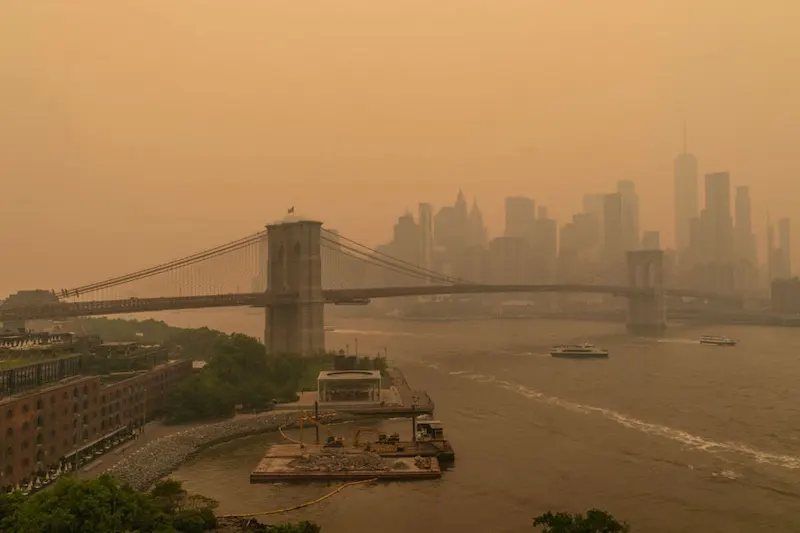


The United States is facing its worst year for smoke exposure in decades, as wildfires in Canada have sent toxic plumes drifting across the border to the Midwest and East Coast. According to a Bloomberg CityLab analysis of federal data, cities such as New York, Chicago, and Washington, DC experienced more “very unhealthy” and “hazardous” air quality days in June and July than in any previous year since the Environmental Protection Agency began tracking fine particle pollution (PM2.5).
Exposure to PM2.5 particles, the main pollutant found in smoke, can have severe health consequences, including an increased risk of heart and respiratory diseases, as well as premature death. Researchers at Stanford University’s Environmental Change and Human Outcomes Lab found that in the first half of this year, the average American has been exposed to more than 400 micrograms of PM2.5 pollution per person from wildfire smoke, which is already more than the cumulative exposure for any year between 2006 and 2022.
The fact that 2023, which has been a relatively quiet fire year in the West, has already surpassed all previous years in terms of smoke exposure is concerning. This is due in part to the large number of people on the East Coast who have been exposed to the smoke. As the wildfire season in Canada continues into August and the US experiences its own wildfire season, the cumulative exposure to smoke will only increase.
The recent smoke-filled days in cities like New York, Chicago, Milwaukee, and Detroit highlight the far-reaching threats that climate-fueled wildfires pose to air quality. These cities, which have typically benefited from clean air regulations enacted over the last few decades, have seen their air quality deteriorate. In the past, the West has been hit harder by wildfires, but now cities across the country are being affected.
The progress made in cleaning the air through regulations like the Clean Air Act of 1970 is at risk of being undone by more intense wildfires. The decline in air pollution witnessed over the years is slowing down as wildfires become a significant source of PM2.5 pollution. In some states, progress has even started to reverse, with wildfire smoke causing an increase in pollution concentrations.
Regulating the impact of wildfires under the Clean Air Act is a challenge, as currently, they are considered "exceptional events," and their contributions to air pollution are not counted against impacted states. However, prescribed burns, which can help mitigate the intensity of natural wildfire events, are included in the calculations. Addressing this regulatory challenge and finding solutions for transboundary pollution will be crucial moving forward.
Despite the challenges, experts believe that the increasing frequency and severity of wildfires will push officials to take significant actions, just as previous episodes of severe air pollution have prompted lawmakers to enact sweeping regulations. It is essential to recognize the link between wildfires, climate change, and air quality and to implement measures that mitigate the risks and protect public health.