


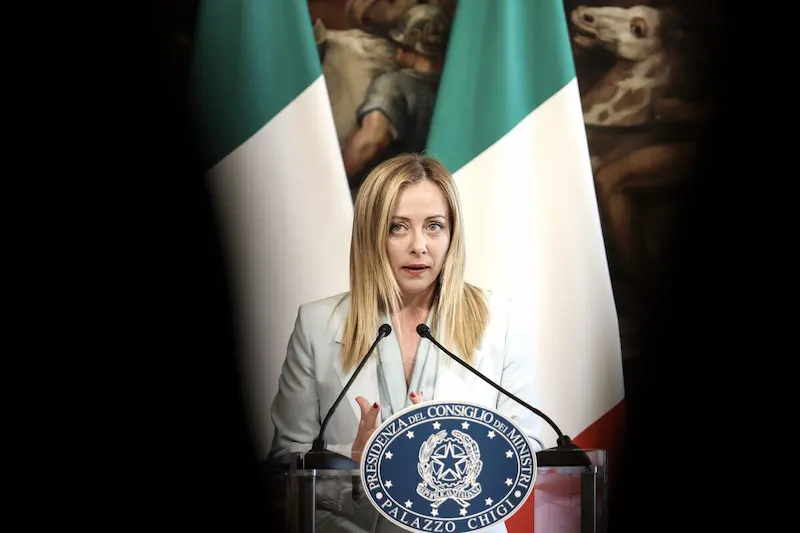


After almost a year in office, Italian Prime Minister Giorgia Meloni is beginning to assert her own brand of hands-on capitalism with greater vigor, and this is causing some investors to feel uneasy. While she initially promised to follow the mainstream approach of her predecessor Mario Draghi, Meloni has recently taken a series of interventionist actions, ranging from regulating airline fares to taxing bank profits.
Since the passing of former Prime Minister Silvio Berlusconi, who was a proponent of capitalist-friendly policies, voices advocating for a more market-oriented approach have been marginalized. This has resulted in the government becoming more of a partnership between Meloni, the president of the Brothers of Italy party, and Matteo Salvini, the leader of the populist League party.
One of Meloni's most controversial moves was to levy a 40% tax on bank profits, a decision that was approved by her cabinet in August without consulting Forza Italia leader Antonio Tajani. This unexpected move carries the risk of increased volatility for Italy, the third-largest economy in Europe.
While the impact of the bank profit tax on the Italian banking industry is expected to be relatively modest, with Intesa Sanpaolo estimating it to have an impact of less than €1 billion on the firm, it still raises concerns among investors. However, according to Intesa Chairman Gian Maria Gros-Pietro, the Italian banking industry is currently performing well due to a resilient economy.
As the Italian economy faces challenges, Meloni will need to demonstrate her ability to implement her agenda. A surprising contraction in second-quarter GDP makes it more difficult for the first female Italian premier to find the necessary funds to fulfill her promises, maintain her coalition, and appease cautious bond markets.
Despite being absent from an annual symposium with investors and executives, Meloni's administration has so far adhered to fiscal prudence, keeping the spreads between Italian and German bonds below 200 basis points. Having witnessed the collapse of the government under Berlusconi in 2011 due to a spike in bond spreads, Meloni understands the importance of market stability.
Experts suggest that Meloni is trying to strike a pragmatic balance, engaging in a more activist role in corporate affairs but avoiding actions that would antagonize the markets. Her government is likely to slightly widen the deficit to finance measures such as tax cuts on wages, but it will proceed cautiously.
Meloni's party, the Brothers of Italy, continues to maintain a strong lead in the polls, with around 29% of support. As long as the prime minister maintains her approval ratings and keeps financing costs in check, she has the flexibility to pursue a more interventionist approach.
In addition to the bank tax, Meloni's government has introduced measures to regulate airlines' use of algorithms to set ticket prices, with the aim of protecting consumers from sudden price spikes. This move has faced backlash from the airlines. The government has also granted itself the authority to block technology transfers to non-European Union countries in strategic sectors such as AI, semiconductors, aerospace, and energy.
Meloni's timing has been advantageous. As she assumed power, several key officials in state-owned companies and other institutions were nearing the end of their terms, allowing her to appoint individuals more aligned with her agenda. This includes changes in prominent positions within Italian corporations and appointing a new governor for the Bank of Italy, who sits on the European Central Bank's Governing Council.
According to Mario Monti, a former prime minister, Meloni's government has positioned itself to engage with international markets and allies. However, as the budget for the next year approaches, financial legislation and potential divestment of selected state-owned companies, such as Ferrovie dello Stato SpA and Banca Monte dei Paschi di Siena SpA, will be critical considerations.
Meloni's approach reflects her right-wing tradition, which emphasizes strong state intervention in the economy. Italians have shown support for Meloni because they seek security, with the nation-state seen as a potential guarantor of that security. As Meloni asserts her authority and implements her agenda, the balance between state intervention and market forces will continue to shape Italy's economic landscape.