


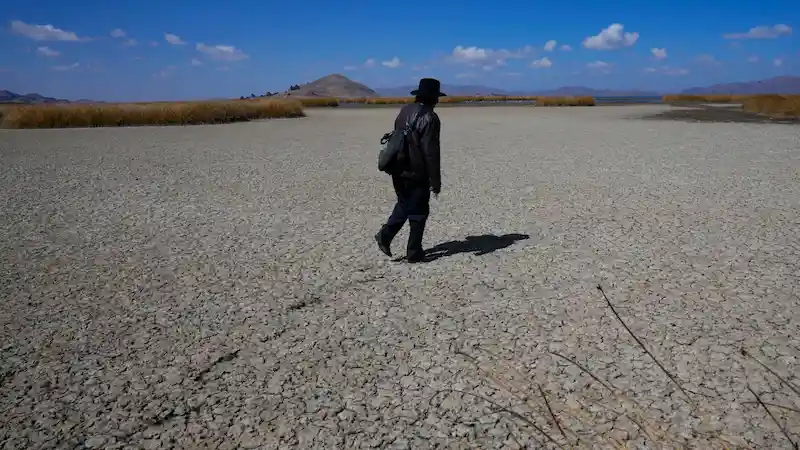


Water levels at Lake Titicaca, the highest navigable lake in the world and South America's largest, are experiencing a shocking and precipitous decline. This unprecedented drop in water levels is a direct result of an extreme winter heat wave, which has had detrimental effects on the local community. The decreasing water levels are not only impacting tourism, but also fishing and agriculture, which are crucial for the livelihood of the residents.
Lake Titicaca has long been a popular destination for visitors due to its stunning blue waters and expansive skies. Spanning over 3,200 square miles across Peru and Bolivia, this "inland sea" is home to indigenous communities like the Aymara, Quechua, and Uros. Situated at an altitude of approximately 3,800 meters in the Andes mountain range, it holds the title of the highest navigable lake in the world. However, this extreme altitude also exposes the lake to high levels of solar radiation, leading to increased evaporation and subsequent water loss.
With a population of over three million people relying on the lake for fishing, farming, and tourism, the declining water levels are posing a significant threat to the region's economy. The effects of the climate crisis have exacerbated the natural fluctuations in water levels, resulting in more extreme changes. A record-breaking winter heat wave has intensified evaporation and worsened the already-existing water deficits caused by drought.
Experts from Peru's national meteorology and hydrology service (Senamhi) report that precipitation in the area has been 49% lower than average from August 2022 to March 2023. This critical period includes the rainy season when water levels typically recover. If the lake continues to evaporate at this alarming rate, water levels are projected to reach their lowest point since 1996 by December, a situation described as "very serious" by Senamhi.
This decline in water levels is not an isolated incident but part of a gradual trend observed in recent years. A study analyzing satellite images from 1992 to 2020 revealed that Lake Titicaca is losing around 120 million metric tons of water annually, primarily due to changes in precipitation and runoff patterns.
The subsistence economy of fishing communities around the lake has been severely affected by low water levels, exacerbating existing challenges such as declining fish stocks caused by pollution and overfishing. Additionally, agriculture has also suffered due to drought, with crops experiencing significant damage during the last harvest season. Local staples like quinoa, potatoes, and oats used for livestock feed have been negatively impacted.
Furthermore, the tourism industry has taken a hit as boats used to transport visitors across the lake have been stranded due to receding waters. The area's already marginalized economy has been further distressed by the consequences of the COVID-19 pandemic and social unrest. Puno, the region encompassing the Peruvian side of Lake Titicaca, has long been synonymous with underdevelopment and marginalization within the country.
Local textile merchants like Jullian Huattamarca rely heavily on tourism, and the decreasing water levels have affected their livelihoods. The absence of visitors during recent protests has added to their woes, deterring potential tourists from venturing into the region. As a result, many people have been forced to leave the area in search of better opportunities or basic necessities like food, exacerbating the region's existing challenges.
Historically, droughts have triggered waves of migration as the subsistence economy collapses due to a lack of food. A previous drought in 1991 resulted in significant population movements. The current drought crisis threatens to create similar consequences, compelling more people to abandon their homes.
For the indigenous Uros community, such as Nazario Charca, the diminishing water levels pose an additional threat. The Uros people live on floating islands made of dried totora reeds, which are now becoming scarce due to lower water levels. The sustainability of their way of life and their ability to continue weaving these reeds into islands, buildings, and boats are at risk.
Looking ahead, the future seems bleak. The current El Niño event, characterized by warmer-than-normal temperatures in the tropical Pacific Ocean, is expected to continue until at least February 2024. These conditions will contribute to lower levels of rainfall in the Andean region surrounding Lake Titicaca.
Addressing this crisis requires long-term strategies to protect the communities that depend on the lake. While fluctuations in water levels are influenced by climate variability and natural oscillations, the exacerbating impact of climate change emphasizes the need for sustained management and mitigation efforts. The vulnerability of local communities primarily reliant on the lake for their livelihoods underscores the urgency to address the intensified fluctuations in water levels.