


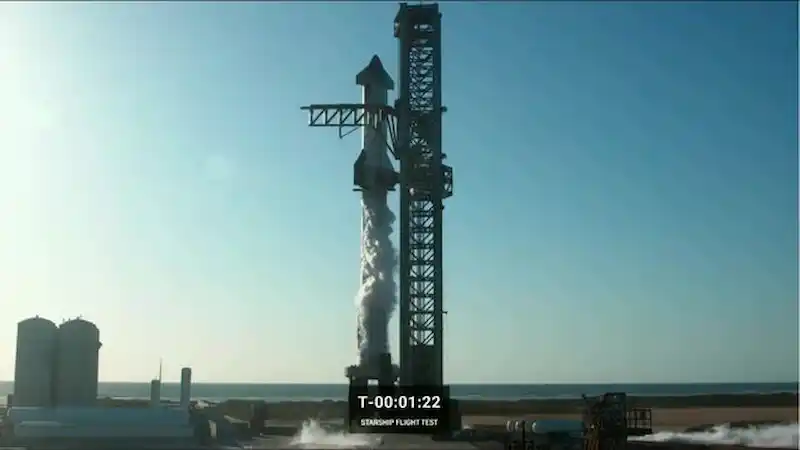


SpaceX, the space exploration company owned by entrepreneur Elon Musk, has announced that the launch of its next-generation Starship rocket has been delayed for at least two days. This is a blow to the company's ambitions to send crewed missions into deep space. The announcement was made just 10 minutes before the scheduled launch, after engineers were unable to resolve a "pressurization issue" during final preparations. SpaceX stated that it would need at least 48 hours before it could attempt an uncrewed test flight of its massive Starship vehicle again.
The rocket was due to be launched from a facility in Boca Chica, Texas, where SpaceX has been testing components of the rocket system in preparation for this launch, its first attempt to reach space. The Starship rocket is more powerful than any previous crewed spacecraft, and taller than the Saturn V. SpaceX has designed the launch vehicle system to be fully reusable, which it promises will reduce costs. The company plans to use the Starship rocket to bring people, including NASA astronauts, and cargo such as satellites into Earth's orbit and beyond.
The latest delay adds to a timeline that has already been almost two decades in the making. As early as 2005, Musk alluded to plans for a giant rocket codenamed "BFR". The uncrewed test flight was to come after the Federal Aviation Administration granted SpaceX a long-awaited launch license for the inaugural flight to space for the fully assembled vehicle.
When the launch attempt happens, the Super Heavy booster rocket is expected to break away from Starship after an initial climb to space and do a controlled dive into the Gulf of Mexico. If everything goes as planned, the Starship spacecraft will continue onward and arc through space completing almost a full lap around the Earth. It will then land in the Pacific Ocean off the coast of Hawaii.
This delay is not the first setback for Starship, which has been beset by delays and mishaps. SpaceX has previously sent prototypes to heights of 32,800 feet with the goal to land them back on Earth. Multiple vehicles blew up. Despite the challenges, SpaceX remains committed to its goal of launching crewed missions to the moon and deep space destinations such as Mars.