


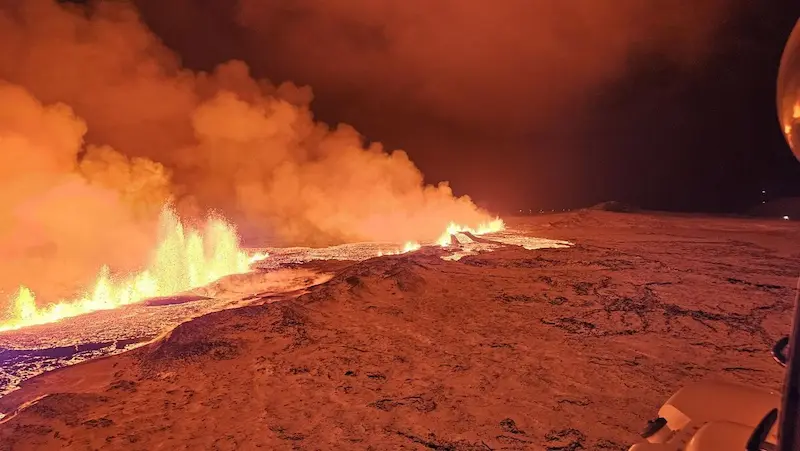


A mesmerizing volcanic eruption has captivated the world as lava surges through a 4-kilometer long crack on Iceland's Reykjanes Peninsula. The dramatic event unfolded near the evacuated fishing town of Grindavík, with lava shooting as high as 100 meters (330 feet) into the sky. While volcanic eruptions have the potential to temporarily cool the planet, this particular eruption is unlikely to have a significant climate impact despite its breathtaking visuals.
Volcanic eruptions have a cooling effect when they expel ash and compounds like sulfur dioxide into the atmosphere. Sulfur dioxide reacts with water to form aerosols, minute particles that act like mirrors, reflecting incoming solar radiation back into space. Consequently, less heat reaches the Earth. Additionally, the presence of sulfur dioxide can enhance cloud formation, further reflecting solar radiation away from the planet. When the atmosphere contains substantial amounts of volcanic aerosols, the cooling effect can span several years and affect entire hemispheres.
The eruption of Mount Pinatubo in 1991 serves as an example of this phenomenon. Roughly 15 million tons of sulfur dioxide released into the atmosphere led to a global average temperature drop of 0.6°C (1.1°F). However, the Icelandic eruption is unlikely to generate a large ash cloud due to the specific conditions surrounding it. Since the magma emerged on land instead of interacting with water, the resulting ash plumes are less explosive. In contrast, the Eyjafjallajökull eruption in 2010, which involved lava coming into contact with ice, produced a massive ash cloud that disrupted European air travel for weeks.
The composition of the magma also plays a role in determining the likelihood of major ash clouds. According to Jonathan Fink, a geology professor at Portland State University, the type of magma involved in the Icelandic eruption, basalt, tends to eject less material high into the atmosphere. As a result, the eruption is not expected to release significant aerosols capable of reflecting sunlight.
While volcanic eruptions can sometimes contribute to warming by emitting greenhouse gases into the atmosphere, the amount released is typically dwarfed by human emissions. Drew Shindell, a professor of Earth sciences at Duke University, explains that the relatively small scale of the Icelandic eruption means it is unlikely to cause any warming. Therefore, the eruption's emission of greenhouse gases is negligible.
Given the eruption's limited aerosol production and minimal greenhouse gas emissions, it is unlikely to have a meaningful impact on global temperatures. Unfortunately, the world will not receive respite from the ongoing challenges of global warming. In addition to climate change driven by human activities, the natural phenomenon of El Niño is more likely to contribute to rising temperatures in the coming year. Therefore, while Iceland's volcanic eruption is a spectacular event, its implications for global cooling are negligible in the face of broader climate trends.