


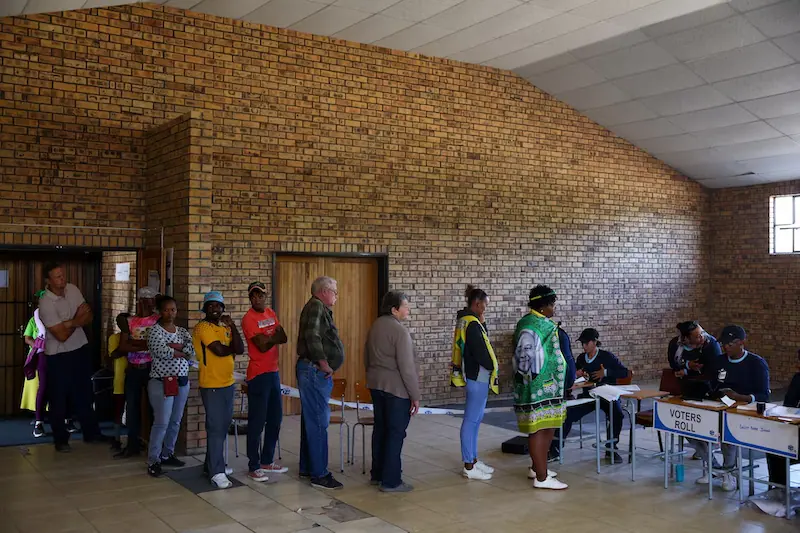


Historically, in the wake of the apartheid era, South Africa is witnessing its most rigorous election, with the ruling African National Congress (ANC) party potentially standing to lose its 30-year parliamentary majority. Despite the night descending, polling stations were still buzzing with locals lined up to vote. Sy Mamabolo, the Chief Electoral Officer, announced in a press meet that the erstwhile 66% turnout from 2019 is expected to be surpassed.
Even though polling stations were set to close by 9 p.m. (1900 GMT), anyone who had arrived would be permitted to vote. Mamabolo later noted an unexpected surge of massively distributed votes in substantial urban areas.
Public concerns around escalating unemployment, frequent power cuts, crime rates, and corruption within the ANC were announced as the motivations of many voters to consider opposition parties. Skhumbuzo Mnyandu, a 48-year-old businessman and lifelong ANC supporter, shared that although he respects the party for its role in securing freedom, he chose to vote for the uMkhonto we Sizwe (MK), a new party backed by former president Jacob Zuma.
Other voters, like 62-year-old Charles Louw, distrust new parties and express loyalty to ANC, citing its experience in dealing with key issues. The ANC, which was formerly led by Nelson Mandela, has maintained the majority in national elections since South Africa's first multi-racial election, held in 1994.
Notably, among young voters, there was increased disappointment with ANC, blaming the party for the lack of job prospects. These sentiments pushed voters like 28-year-old Nosipho Mkhize toward the MK.
If ANC fails to secure at least 50% of the votes, it would need to form a coalition government, a scenario that would pose challenges to South Africa's young democracy.
The elections will determine the provincial assemblies across the country's nine provinces, culminating in the formation of a new national parliament that will elect the next president. Despite doubts, ANC leader President Cyril Ramaphosa is anticipated to retain his position, provided the party manages to secure the largest vote share.
Over 27 million South Africans enrolled to vote at 23,000+ polling stations. However, the falling turnout rates since the democratisation of the nation have been a potent factor in the present elections.
With nearly 93% of the polling stations operating on schedule, only sporadic issues were reported, including voters registration-related complications and delays due to missing ballot papers.
Emerging from a polling station in Soweto, President Ramaphosa expressed his strong belief that ANC will receive the public's trust. Meanwhile, opposition parties like the pro-business Democratic Alliance (DA) and the Economic Freedom Fighters (EFF) have encouraged larger voter turnouts.
Interestingly, EFF, led by Julius Malema, former ANC youth head, aims to nationalise mines and banks and reclaim lands from white farmers to rectify racial and economic injustices. While EFF's expected votes fall between 10-12%, far behind ANC's 37-44%, Malema's position might prove consequential based on the final election results.
The new MK party (backed by Zuma) is expected to impact both ANC's and EFF's vote shares, particularly in the Zuma-leaning KwaZulu-Natal province. The official results of the election should be announced within a few days following the close of polling.