


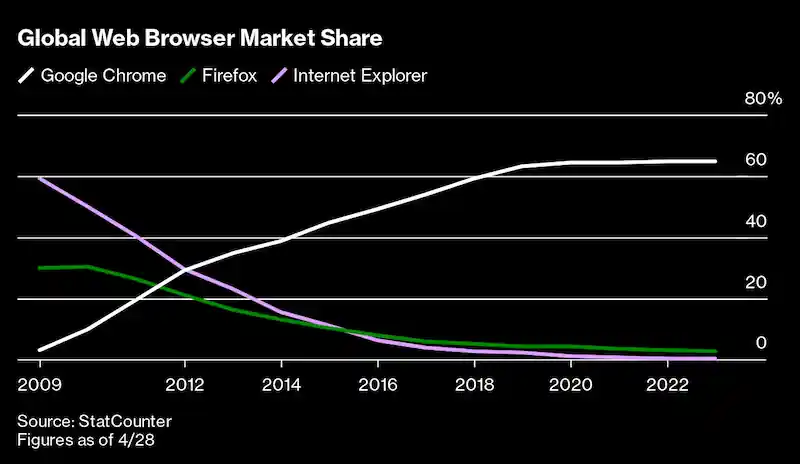


Mozilla, the non-profit organization behind the Firefox web browser, has been struggling with an identity crisis as its flagship offering has lost significant market share. While Mozilla has been working on a range of projects and products to promote its mission of ensuring an open and accessible internet, none have achieved anything close to the success of Firefox. However, Mozilla does have a significant amount of money in reserve, with over $1 billion in cash reserves, according to its latest financial statement. The primary source of this capital is Google, which pays Mozilla to be the default search engine on the Firefox homepage. These payments, which started in 2005, have been increasing and were up 50% over the past decade, to more than $450 million, even as the total number of Firefox users has plummeted. In 2021, these payments accounted for 83% of Mozilla’s revenue.
Google and Firefox have had a close relationship since the beginning, with Google assigning coders to help develop Firefox, which eventually took a 30% share of the browser market. In return, Firefox promoted the Google search engine on its homepage. However, Google has now largely displaced Firefox in the browser market, with its Chrome browser accounting for about two-thirds of the global market based on usage, according to data company Statcounter. Firefox's market share is less than 3% and significantly lower on mobile.
Critics say that the Mozilla-Google deal makes little commercial sense given Firefox’s dwindling user base. While it is not unusual for tech companies to pay for default search engine status, the amount of money Google pays Mozilla seems unusually high given Firefox's shrinking market share. Some have suggested that Google's support for Mozilla is a way to deflect antitrust scrutiny. While Google faces multiple antitrust lawsuits, it pays Mozilla to be the default search engine on Firefox.
Mozilla's reliance on Google may be awkward, given Google's status as a "monopoly gatekeeper for the internet," according to the US Department of Justice. While Mozilla was active in efforts to address Microsoft's power in the browser market, it has been noticeably less active in efforts to address Google's power. However, Mozilla spokesperson Brandon Borrman says that the organization continues to push for an open internet in an era when that vision is under threat.
Mozilla has had some successes beyond Firefox, such as the Pocket web bookmarking tool, which it acquired in 2017, and a subscription-based virtual private network. The organization also plans to build infrastructure for the metaverse and an open-source social network. It recently announced the creation of two new subsidiary companies: Mozilla.ai, which will work on creating artificial intelligence tools with transparency and user controls, and Mozilla Ventures, which plans to invest $35 million in "responsible tech companies."
Mozilla's product offerings split into a small foundation and a commercial arm that controls most of the combined entity’s resources. Mitchell Baker, a lawyer who helped establish Mozilla in 1998, is the chair of the board of both the foundation and the corporation, as well as the chief executive officer of the corporation. Mozilla had $340 million in expenses in 2021, about $240 million of that in salaries and benefits. Mitchell Baker's annual compensation was $5.6 million. Mozilla cut 70 jobs from its core engineering teams at the start of the pandemic and 260 from across the corporation at the end of the year. The current headcount is 1,070.
While Mozilla has struggled to find another hit like Firefox, the organization has made significant contributions to improving the internet, according to Borrman. Mozilla has been successful in getting "Big Tech" companies to change their practices in a manner that benefits consumers over increasing their profits. However, with Firefox's market share continuing to decline, Mozilla will likely need to find new ways to promote its vision of an open and accessible internet.