


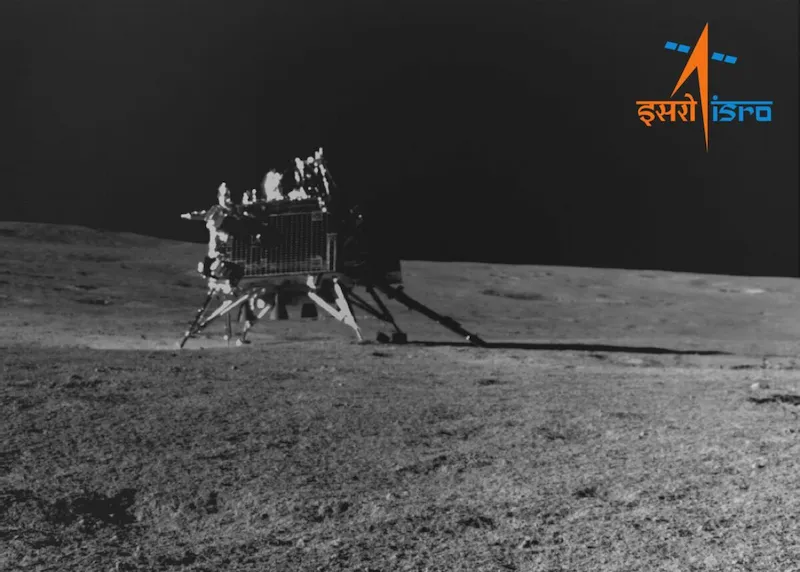


India's lunar rover has completed its mission on the moon's surface and has now entered sleep mode after its historic landing near the lunar south pole. The Indian Space Research Organization (ISRO) announced that the rover has concluded its assignments and is safely parked. With daylight on that part of the moon coming to an end, the rover is now set to rest.
During its time on the lunar surface, the rover collected valuable data, which has been transmitted back to Earth via the lander. The rover's payloads have been turned off, and the battery is fully charged. The solar panel is positioned to receive sunlight at the next sunrise expected on September 22, 2023. The receiver, however, remains operational, and scientists are hoping for a successful awakening for another set of assignments.
One of the primary objectives of the mission was to search for signs of frozen water on the lunar surface. This finding could be crucial for future astronaut missions, providing a potential source of drinking water and even rocket fuel. However, there is no information yet on whether the rover was successful in this regard.
Earlier in the week, the ISRO reported that the rover identified the presence of sulfur and detected various other elements on the moon. Additionally, its laser-induced spectroscope instrument found aluminum, iron, calcium, chromium, titanium, manganese, oxygen, and silicon on the moon's surface.
Although the rover's mission has been a significant accomplishment for India, there are uncertainties about its survival in extremely low temperatures. The electronics on board were not built to withstand temperatures below minus 120 degrees Celsius (minus 184 degrees Fahrenheit) experienced during the lunar night, which lasts for 14 days on Earth. With such frigid conditions, there is a chance that the rover may not reawaken at sunrise due to the electronic systems' inability to endure extreme cold.
The data collected by the rover has been returned to Earth and will undergo analysis by Indian scientists as an initial step. Subsequently, the global scientific community will also contribute to studying the findings.
India's successful lunar mission follows a failed attempt in 2019 and has established the country as the fourth nation to achieve this milestone, joining the United States, the Soviet Union, and China. This noteworthy achievement enhances India's reputation as a technology and space powerhouse and aligns with Prime Minister Narendra Modi's vision of showcasing India as an emerging global force.
With a cost estimate of $75 million, the mission began over a month ago. India's triumph coincided with Russia's Luna-25 mission, which aimed to land in the same lunar region but unfortunately spun into an uncontrolled orbit and crashed. The failure was attributed to a lack of expertise resulting from the prolonged hiatus in Russian lunar research since the last Soviet mission in 1976.
India's space endeavors date back to the 1960s, and the country has successfully launched satellites for itself and others. Notably, India accomplished placing a satellite into orbit around Mars in 2014. Moreover, the country is planning its debut mission to the International Space Station in collaboration with the United States, expected to take place next year.