


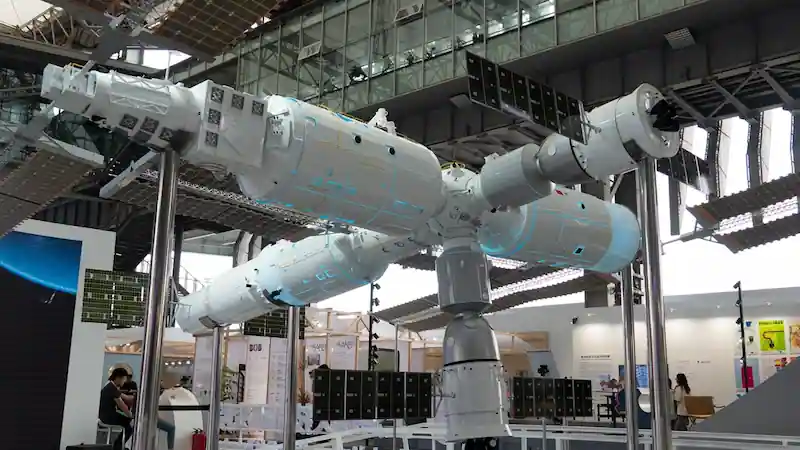


China is gearing up to outshine the NASA-led International Space Station (ISS) by expanding its own space station, offering a promising alternative for near-Earth missions. The Chinese space station, named Tiangong, is set to undergo significant growth, going from three modules to six, providing a platform for astronauts from other nations to conduct their space endeavors.
Recently, the China Academy of Space Technology (CAST), a subsidiary of China's primary space contractor, revealed at the International Astronautical Congress that the operational lifespan of the Chinese space station will extend beyond the previously announced 10 years. Instead, it will boast a lifespan of over 15 years, making it a long-term option for space missions.
Since late 2022, Tiangong has been fully operational, accommodating a maximum of three astronauts at an orbital altitude of up to 450 kilometers (280 miles). However, even after its expansion to six modules, Tiangong will only be 40% of the mass of the ISS, which currently holds a crew of seven astronauts. Although smaller in size, China's space station is expected to play a significant role in space exploration as the ISS approaches retirement in the 2030s.
Chinese state media reported last year that several countries have expressed interest in sending their astronauts to Tiangong, indicating that China's space station is already gaining international recognition. Nevertheless, China faced a setback when the European Space Agency (ESA) announced it lacked the funding and "political" approval to participate in Tiangong, causing a halt to the long-planned visit by European astronauts—a blow to China's space diplomacy ambitions.
However, despite this setback, China remains determined to assert its dominance in the space domain. Tiangong has become a symbol of China's growing influence and confidence in its space ventures, challenging the United States in the realm of space exploration. Although prohibited by US law from collaborating with NASA directly or indirectly, China aims to establish itself as a major space power by the same time the ISS is decommissioned in 2030.
Russia, another participant in the ISS, is also planning its own space station as an alternative. It has suggested that its partners in the BRICS group—Brazil, India, China, and South Africa—come together to construct a module for its station. Roscosmos, the Russian space agency, disclosed its plans last year, intending to build a space station comprising six modules capable of accommodating up to four cosmonauts.
As the race for dominance in space continues, China's ambitious expansion plans for Tiangong, along with Russia's pursuit of its space station, underscore the evolving dynamics and competition in the realm of space exploration. The expansion of Tiangong provides a glimmer of hope for countries looking to collaborate and participate in near-Earth missions beyond the ISS era.