


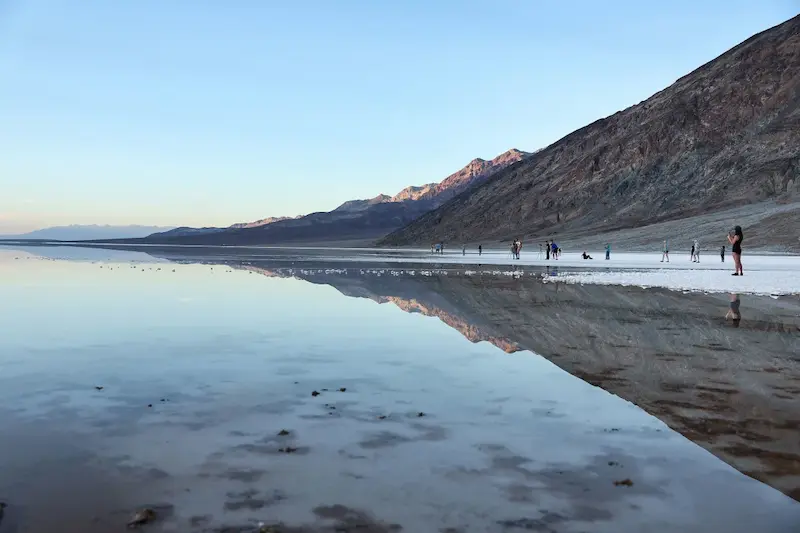


In a remarkable turn of events, Death Valley, known as the hottest and driest place in North America, has transformed into a temporary oasis following the excessive rainfall brought by Hurricane Hilary. This rare occurrence has left the park's grounds resembling ponds, with wildflowers blooming in remote corners and a salt flat now transformed into a sprawling lake. According to Death Valley park spokesperson Abby Wines, this extraordinary phenomenon only happens about once a decade, making it a truly special sight to behold.
The unprecedented rainfall of 2.2 inches, which occurred in just 24 hours on August 20, marked the wettest day ever recorded in Death Valley's history. Prior to this, the park had never experienced more than 2 inches of rainfall in a single day since 1911. However, the parched desert soil was unable to absorb the deluge of water quickly enough, resulting in flash flooding that washed away trails and caused significant damage throughout the park.
Due to the severity of the damage, Death Valley National Park was forced to close from late August to mid-October — the longest closure in its history, according to Mike Reynolds, the park's superintendent. Fortunately, the park has now partially reopened, allowing visitors to witness some of the extraordinary sights, although some may remain forever out of reach.
In the immediate aftermath of Hurricane Hilary, floodwaters pooled in various locations within the vast park, including the Mesquite Flat Sand Dunes. However, these pools have since dried out, leaving behind only mud cracks as evidence of their existence. Additionally, the excess water caused wildflowers to bloom ahead of their typical schedule in a remote area that is difficult for most visitors to access.
The most awe-inspiring result of Hurricane Hilary's downpour can still be witnessed firsthand, albeit for a limited time. Badwater Basin, the lowest point in North America, has been transformed into a temporary lake spanning several miles, according to the National Park Service. Given its location at 282 feet below sea level, it is not surprising that floodwater accumulated here. What is astonishing, however, is the water's persistence. Even nearly two months after the historic floods, the water remains trapped in the basin.
Abby Wines describes the water's staying power as a consequence of the copious rainfall from Hurricane Hilary, stating that it will take time for the water to evaporate, even in the arid desert climate. A month after the storm, Wines ventured out in a kayak to gauge the depth of the lake and estimated it to be about a foot. As time has passed, the water has receded, and it is anticipated that the lake may dry up within a few weeks, depending on the weather conditions.
The longevity of the temporary lake primarily hinges on the weather in the coming weeks. The faster the water evaporates, the shorter its lifespan will be. However, with the average high temperatures in Death Valley dropping rapidly during the fall and far from the scorching heat of summer, the pace of evaporation may slow down. Forecasts indicate that high temperatures will dip into the 80s later this week and peak in the 70s early next week. Consequently, this may extend the presence of water in Badwater Basin, and according to Wines, there may be some water visible until November.
For those eager to witness this remarkable phenomenon, Wines advises visiting sooner rather than later. The extraordinary transformation of Death Valley into a temporary oasis is a sight worth experiencing, but its fleeting nature highlights the need to seize the opportunity while it lasts.