




As electric vehicles (EVs) continue to gain popularity, one ongoing concern for drivers is the availability and reliability of charging infrastructure. With approximately 50,000 public charging stations in the United States compared to 145,000 gas stations, the fear of running out of power during a trip is a real source of anxiety. Furthermore, over 20% of EV drivers in the US have encountered malfunctioning charging equipment, according to a study by J.D. Power.
To address this issue, several startups are developing mobile chargers as a potential solution. These mobile chargers come in various forms, ranging from clunky metal boxes on wheels to sleek robots ready to navigate parking lots. Although initially geared towards fleets that often lack charging infrastructure, the technology may become more widespread for everyday drivers in the future.
The charging network being built across the US is crucial for instilling confidence in EV drivers that they can travel long distances. However, mobile chargers offer a different and nuanced approach to charging, which may find its place in the market, explains Alan Jenn, an assistant professor at the Institute of Transportation Studies at the University of California, Davis.
One example of a mobile charger is the Lightning Mobile, developed by EV manufacturer Lightning eMotors. Weighing a sturdy 9,900 pounds (4,500 kilograms) and priced at over $300,000, the Lightning Mobile functions akin to a generator. It can be rolled out to any location where charging infrastructure is lacking, such as remote areas, event spaces, and fleet depots. Up to four vehicles can plug into the unit simultaneously. Despite its hefty weight and cost, Lightning eMotors has experienced increased interest and demand in the mobile charger on the West Coast, where EV adoption is rapidly growing.
These mobile charging solutions can be invaluable for traversing "charging deserts" – regions with long stretches of road lacking public charging infrastructure, like the Appalachian Trail or Route 66. Additionally, they can serve as lifesavers during power outages caused by natural disasters or grid failures, providing backup power to EV owners.
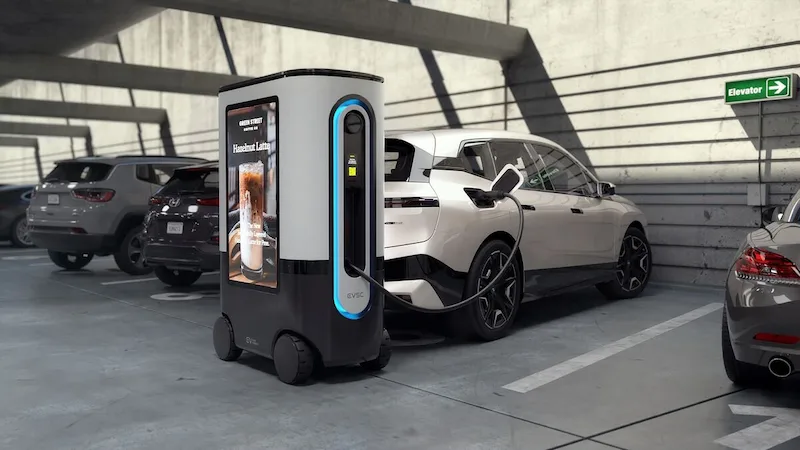
Another innovative solution is an autonomous rolling robot named ZiGGY, developed by the Los Angeles-based startup EV Safe Charge. ZiGGY is designed to operate in parking lots and garages and can be reserved by drivers via an app. Once the driver arrives, the robot occupies a designated parking space and serves as a mobile charger. EV Safe Charge recently won a contest held by the city of Barcelona and plans to pilot ZiGGY in municipal parking garages there. This shareable mobile charger concept has the potential to be a game-changer for urban areas, such as apartment buildings or airports, where space is limited.
Massachusetts-based company SparkCharge has created the Roadie Portable for businesses in need of charging solutions in various locations, including warehouses and event venues. This mobile charger can fit in the back of an EV and supply up to 20 kilowatts of power. With additional battery units, it can provide up to 14 hours of power. SparkCharge aims to accelerate the transition to a sustainable future by ensuring that EV drivers have access to charging facilities wherever and whenever they need them.
Even without these mobile chargers readily available, AAA has launched a roadside assistance program in 24 cities, providing support to EV drivers who unexpectedly run out of power. Among their assistance options, AAA can dispatch mobile chargers to stranded EV owners, allowing them to charge their vehicles enough to reach their desired destination or a proper charging station.
While the development of mobile chargers is undoubtedly valuable in areas lacking charging infrastructure, as public charging networks continue to improve and expand, the demand for mobile chargers may decrease. However, these chargers on wheels can serve as a temporary solution, bridging the gap until EV drivers gain confidence in the public network. Nevertheless, companies focusing on mobile charging solutions can be successful by identifying the right applications, such as multi-unit dwellings where installing stationary charging infrastructure is challenging.
In the ever-changing landscape of EV charging technology and infrastructure, it is crucial not to dismiss any potential solutions prematurely. Mobile chargers have their place in addressing the concerns of EV drivers, and with ongoing innovation and improvement, they could become an essential component of the charging ecosystem.