


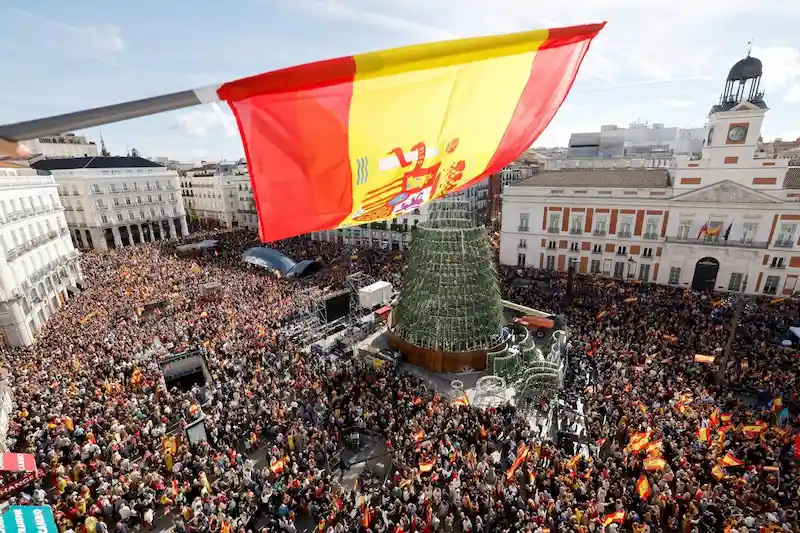


Tens of thousands of people took to the streets of Madrid and other major Spanish cities in a massive protest against the plans of acting Prime Minister Pedro Sanchez to grant amnesty to Catalan separatists involved in a failed bid for independence. The demonstration, organized by the conservative opposition People's Party, aimed to further intensify the pressure on Sanchez as he seeks a new term in a parliamentary vote this month, following a controversial deal with a separatist Catalan party that secured him a majority in return for amnesty.
This protest adds yet another chapter to Spain's ongoing political drama, which originated from the July election where the People's Party won the most seats in parliament but fell short of forming a government. Sanchez, on the other hand, has had to rely on the support of Catalan separatist parties, leading to widespread anger over his agreement with one of the parties involved in the unilateral declaration of independence in 2017.
Sanchez faced criticism and backlash on November 9th when his Socialist party announced an agreement with Junts per Catalunya to propose an amnesty law, benefiting numerous pro-independence activists facing charges for their roles in the failed secession attempt. The government at that time, led by the People's Party, had imposed direct rule over Catalonia. This move infuriated the opposition and received strong condemnation from the judiciary.
Thousands of demonstrators flooded the streets in Madrid, Barcelona, Seville, Bilbao, and Valencia, with an estimated 80,000 people participating in the protest in Madrid alone. Overall, an estimated 271,000 people gathered across 15 cities nationwide, according to El Pais. In Madrid, supporters from balconies above the Puerta del Sol square clapped and waved Spanish flags in solidarity with the protesters. One elderly woman held a sign saying, "Spain, for sale, for 7 votes," referring to the number of Junts lawmakers needed for Sanchez to be reappointed as premier.
These protests come after a week of smaller but intense evening demonstrations outside the headquarters of Sanchez's Socialist Party, which often resulted in clashes with the police. Leading up to the protest, the People's Party consistently called for a peaceful event.
The proposed amnesty law would benefit various individuals, including mid- and high-ranking officials from the Catalan government at the time, school principals, small-town mayors, and others. However, the primary beneficiary would be former Catalan President Carles Puigdemont, who has been living in self-imposed exile in Belgium since the failed secession attempt. Puigdemont himself was personally involved in the negotiations with the Socialist Party. The law is expected to be submitted as early as next week, aligning with the deadline for Sanchez's confidence vote, which must take place by November 27th to avoid yet another election. Currently, Sanchez holds 179 votes from eight parties, needing a minimum of 176 votes in the 350-member parliament for his reappointment.
Addressing the demonstration in Madrid, People's Party leader Alberto Nunez Feijoo stressed the significance of the issue, stating, "This goes way beyond who voted for whom. This surpasses political parties." With the protests growing in size and intensity, the pressure on Sanchez mounts as he tries to secure his role as Spain's prime minister amid the deep divisions surrounding the Catalan amnesty deal.