


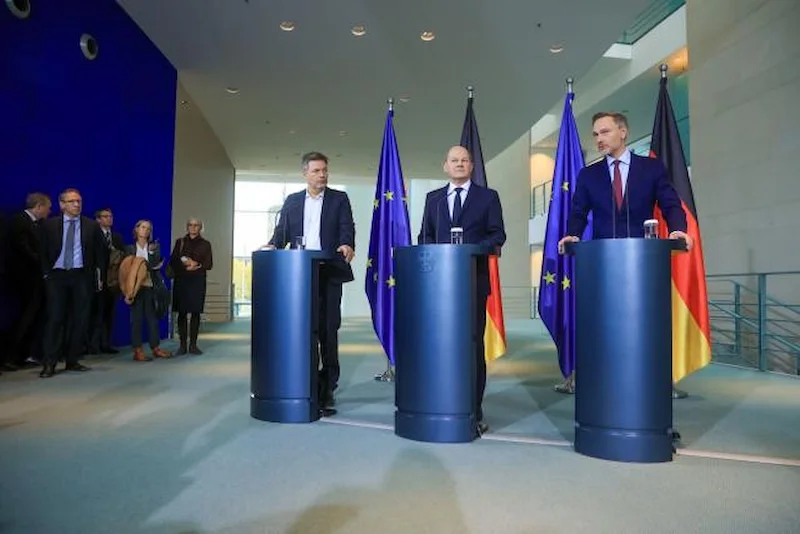


Germany will once again suspend its constitutional limit on net new borrowing for a fourth consecutive year, following a recent ruling by the nation's top court. This emergency measure, known as the "debt brake," will be implemented as part of a revised 2023 budget set to be presented by Finance Minister Christian Lindner next week. The move comes in response to a ruling that forces the government to retroactively account for approximately €37 billion ($40.3 billion) of new off-budget debt, allocated to alleviate the burden of high energy prices on households and consumers.
The decision to suspend the borrowing limit represents a significant backtrack for Lindner, who had been advocating for the reinstatement of fiscal discipline in Germany. The limit was previously lifted for three years due to the pandemic and energy crisis. However, given the court ruling and the necessity to address high energy costs, Lindner now finds himself in a compromised position.
A spokesperson for Lindner's ministry confirmed that the supplementary budget would propose an extraordinary emergency situation for 2023. The intention is to place the funds allocated to ease energy costs on a secure legal basis, without incurring new debt. This move is expected to bring some stability, as uncertainty regarding Germany's debt obligations has caused German bond yields to decline.
The recent ruling by the Constitutional Court in Karlsruhe raised concerns about the financing of the government's special funds, calling into question hundreds of billions of euros. These funds, which are separate from the regular federal budget, were intended for various initiatives, including addressing energy costs, greening the manufacturing sector, and supporting the renewables industry. The government's ability to implement these plans is now in question, leading to a freeze on new spending authorizations.
The delay in next year's finance plan, which was scheduled to be presented to parliament next week, exacerbates the challenge. The government is not only grappling with the potential legal repercussions of overhauling the special funds but also facing the broader and longer-term impact of the court ruling. The uncertainty surrounding the situation makes it difficult to plan for the coming years.
As a result, political leaders are calling for an extension of the suspension of the debt brake. Lars Klingbeil, a co-leader of Chancellor Olaf Scholz's Social Democratic Party (SPD), believes it is politically justified to suspend the debt brake for this year and advocates for a further extension in 2023. He cites the aftermath of the pandemic, the energy crisis, inflation, the war in Ukraine, and the situation in the Middle East as reasons necessitating this suspension.
The debt brake restrictions are enshrined in Germany's constitution but can be temporarily set aside in cases of natural disasters or uncontrollable emergencies. They were previously suspended for three years following the Covid-19 pandemic and the surge in energy costs caused by Russia's invasion of Ukraine. Under these rules, structural net borrowing is limited to 0.35% of GDP, with flexibility for additional borrowing during economic downturns but limited leeway during upswings.
The decision to suspend the borrowing restrictions reflects the challenges faced by Germany in balancing fiscal stability with the need to address critical issues such as high energy costs. This move will provide some breathing room for the government to navigate the legal complexities and plan for the future. However, it also raises questions about the long-term impact on Germany's fiscal stability and the potential for further legal challenges.