


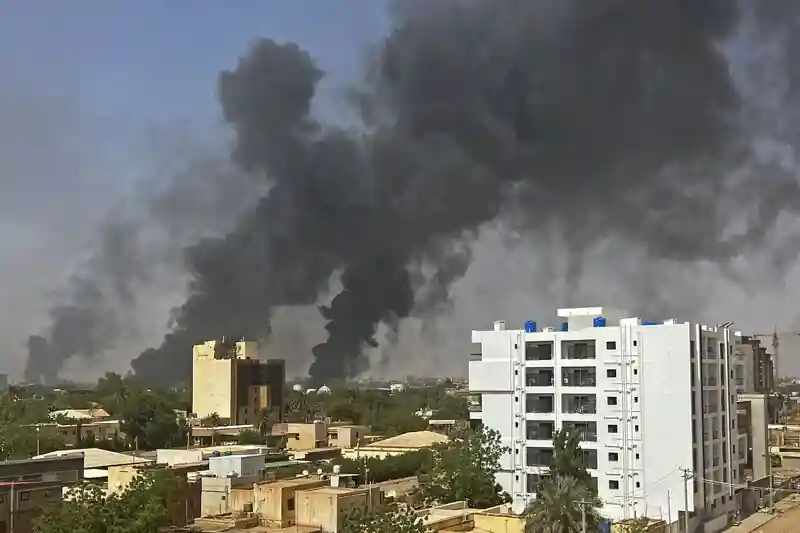


The ongoing conflict in Sudan between the military and the paramilitary group Rapid Support Forces (RSF) has escalated into a deadly battle for control of the country, with hundreds of reported deaths and thousands injured. The situation has raised concerns that the conflict could spiral into a full-blown civil war and draw in regional powers. This violence has disrupted plans for a power-sharing government that was intended to pave the way for democratic elections and potentially restore billions of dollars of frozen foreign aid.
Sudan's military has long been the pre-eminent power broker in the country. It supported dictator Omar al-Bashir for three decades before ousting him in 2019 after months of protests against runaway inflation and state brutality. However, in 2021, the army led by Lieutenant-General Abdel Fattah al-Burhan toppled the uneasy transitional coalition of civilian and military figures that had run the nation after the popular uprising. The coup sparked unrest and a deadly crackdown by security forces, dashing hopes for a speedy transition to democracy. With the generals in near-total control, a long-running rivalry came to the fore between the military and the RSF.
The RSF has roots in the government-backed janjaweed militias that terrorized Sudan's western region of Darfur during fighting there in the early 2000s, and is led by one-time camel trader Mohamed Hamdan Dagalo. A former enforcer for Bashir, Dagalo helped overthrow him in 2019 and became deputy of the quasi-presidential Sovereign Council, basically Sudan's second-in-command. While lacking air power and tanks, the RSF is a seasoned fighting force that has waged counter-insurgencies for years and played a part in the Saudi Arabia-led war against Houthi rebels in Yemen. Under the army's proposed power-sharing pact, the RSF would have been folded into the regular military, losing its independence. This would have been a bitter blow for Dagalo, who is thought to harbor presidential ambitions and has forged close ties with Russia in recent years.
Fighting has engulfed parts of Khartoum, the capital, and there's been violence in at least six states, according to United Nations officials. Both sides have claimed to control key infrastructure such as the international airport and public broadcaster, but it is difficult to verify whether either side has the upper hand. Several cease-fire attempts have failed, stoking fears of a full-blown civil war in the country of 45 million people. Civilians are fleeing affected areas, including to Chad, Egypt, and South Sudan. The US and other embassies have evacuated personnel, and the UN Security Council has urged parties to stop hostilities.
Under Bashir, Sudan became isolated on the international stage, and he spearheaded an Islamist revolution that for a time in the 1990s turned Sudan into a haven for terrorists such as Osama bin Laden. Bashir was later indicted by the International Criminal Court for alleged war crimes and genocide in Darfur. After his ouster, the US rescinded its three-decade listing of Sudan as a sponsor of terrorism, and it was gradually re-embraced by Western countries, which saw in it a potential new ally in Africa as well as an example for democratization in the broader Middle East and the Horn of Africa. They faced competition from China, which has backed port and rail projects, and Russia as it continued a tactic of building influence among the leadership of weaker African states. The Russian mercenary Wagner Group is involved in Sudan's gold-mining sector.
The violence is the latest in a string of setbacks to democracy in Africa, following recent coups in Mali and Burkina Faso. A prolonged conflict in a country that's seen countless insurgencies in its decades of independence could draw in Sudan's neighbors, whether directly or through the backing of proxy forces, with potentially grave implications for regional security and risking the lives of millions. It could also further complicate talks aimed at resolving a standoff over the filling of a giant hydropower dam that Ethiopia is building on a tributary of the Nile River, which threatens to interrupt the water supply downstream in Egypt and Sudan.
Sudan remains one of the world's poorest nations, ranking 170th out of 189 countries on the UN Development Program's human development index. After Bashir's ouster, institutions such as the World Bank and International Monetary Fund discussed renewed support, and its transitional rulers tried to secure Western investment. The 2021 putsch derailed that, prompting many donors to withhold budget support and leaving the military-led government scrambling to cover a funding gap. The Sudanese government tried to diversify the economy by encouraging mining, but it remains a fledgling industry, and most people depend on subsistence agriculture.