


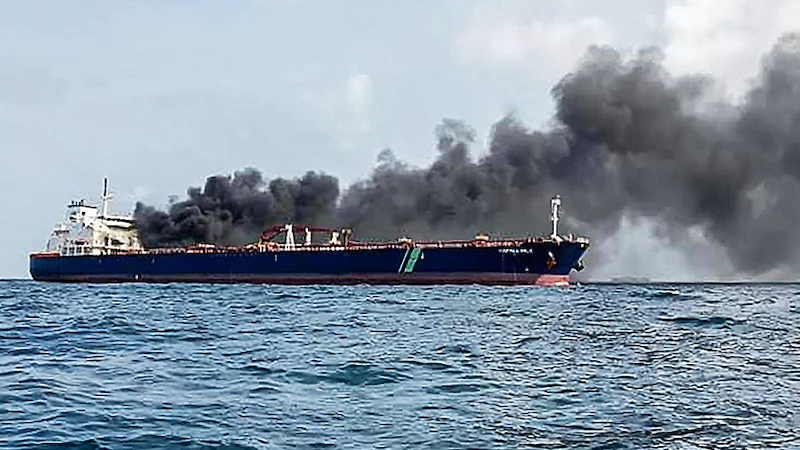


In the early hours of Sunday, Malaysian maritime authorities successfully intercepted the Ceres I, a crude oil tanker hailing from Sao Tome & Principe, off the coast of Malaysia. The vessel had been involved in a collision and subsequent fire with the Singapore-flagged refined-products tanker, Hafnia Nile, in a critical global waterway east of Singapore.
Following the collision on Friday morning, which engulfed both vessels in flames, the Ceres I disconnected its transponder, remaining untraceable for over a day. Nevertheless, Malaysian authorities managed to track the rogue tanker, which was eventually intercepted 28 nautical miles off Tioman Island at 1:20 a.m. local time on Sunday with the assistance of two tug boats. Both vessels involved in the collision along with the detained Ceres I are currently under scrutiny.
Aerial surveillance conducted post-interception revealed traces of a potential spill, prompting further investigation and clean-up efforts in the area. The exact circumstances leading up to the collision and subsequent fire are still under investigation, with authorities working to unearth the root cause.
The Ceres I, a relatively aged vessel built in 2001, had been sailing under a rarely seen flag, a characteristic shared by many vessels within the enigmatic dark fleet. Despite its age, the very large crude carrier (VLCC) had been active in transporting cargoes from Iran and Venezuela in recent times, showcasing a controversial operational history.
As questions linger about the motivations and circumstances surrounding the collision and subsequent actions of the Ceres I, the shipping industry braces for anticipated regulatory scrutiny and potential implications on maritime safety protocols.