


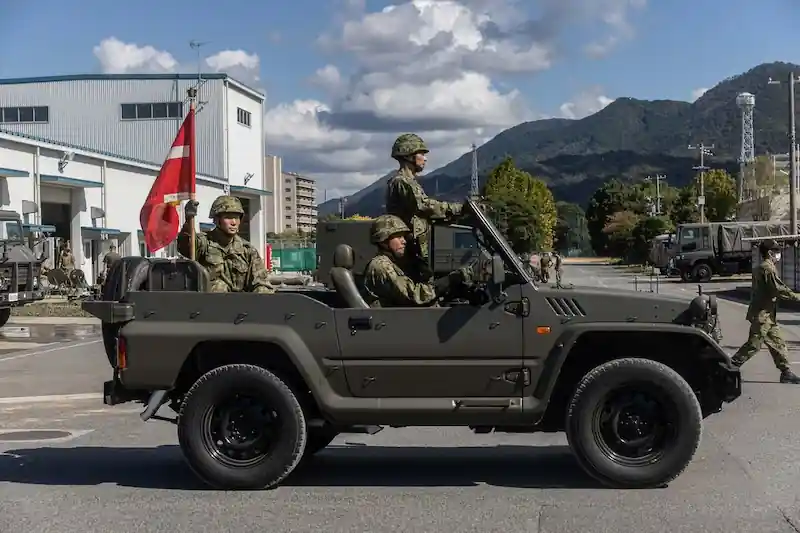


In the center of Hiroshima, where peace is the core of the civic brand, a different view of international relations is being manifested. Prompted by China's increasingly assertive behavior towards its neighbors, Japan is expanding its military at a pace unprecedented in the postwar era. Prime Minister Fumio Kishida is hoping to build support for reductions to nuclear stockpiles at the upcoming Group of Seven industrialized democracies summit in Hiroshima. However, just a short distance from the monuments to the dead, a thriving industrial hub is home to one of Japan's key arms factories, which is preparing to crank up production of artillery pieces and tank cannons. At a shipyard nearby, work is underway on an aircraft carrier - the first such vessel to be operated by Japan since hostilities ended with the US. The area also hosts a major base for the Japanese navy.
Kishida argues that these investments are necessary to deter a regional war. His government's National Defense Strategy describes China as "the greatest strategic challenge in ensuring the peace and security of Japan." China has pursued advanced weapons such as hypersonic missiles and has constructed artificial islands in the South China Sea to cement maritime claims that Japan and its allies reject. A war over Taiwan, an important economic partner for Tokyo, would threaten regional trade, as well as semiconductor factories on which Japanese companies depend.
However, turning Japan into a first-rate military power won't be easy. The country has a long history of troubled defense projects, and it's uncertain whether its modest ranks of arms makers, many of which barely break even on military contracts, will be able to meet new demands. At the same time, the government is anxious about becoming overly dependent on imports. To Kishida and his colleagues, producing weapons domestically is essential if Japan is to take responsibility for its own protection.
The legal and political obstacles could prove more significant, even after Russia's invasion of Ukraine raised the risks of great-power conflict. When Japan surrendered to the US in 1945, it was a shattered nation, despised across Asia for its wartime brutality. Its new constitution, adopted two years later, stated that its people "forever renounce war" and that "land, sea, and air forces... will never be maintained." Although those prohibitions haven't been observed to the letter, what Kishida is proposing is transformative and controversial. Support for pacifism remains widespread, especially among the older voters who decide elections, and there are substantial hurdles to rewriting Article 9, the constitutional provision restricting the military. Even Abe, Japan's longest-serving prime minister, was unable to muster the political capital to do it.
The debate is especially fraught in Hiroshima. The city's leaders have long preferred not to draw attention to the local arms industry. Few want to inflame political tensions, and peace is the core of the civic brand. However, as Kishida and other politicians urge Japanese citizens to consider the implications of a rising China, that's starting to change. "Now is the time for companies in the defense industry to talk openly," says Hideki Fukayama, chairman emeritus of the Hiroshima Chamber of Commerce & Industry. "We can't protect the nation with only what's written in the constitution," he says.