


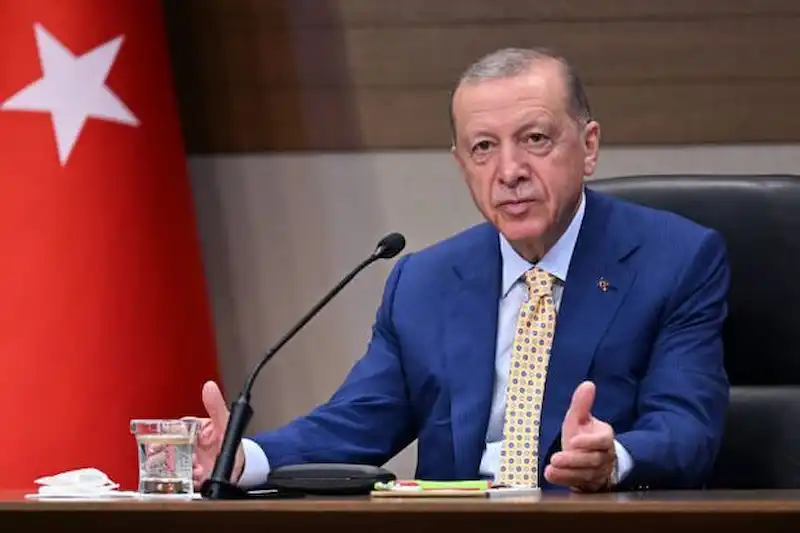


Turkish President Recep Tayyip Erdogan has raised a new obstacle for Sweden's bid to join NATO by linking it to Turkey's ongoing efforts to join the European Union. Erdogan's statement came just hours before a summit where Sweden had hoped to finalize its accession to the military alliance. For over a year, Turkey has been delaying Sweden's NATO application, citing concerns about Sweden's approach to counterterrorism.
During a press conference in Istanbul before his departure for Vilnius, Erdogan stated, "First come and open the way for Turkey in the EU; after that, we'll open the way for Sweden just like we did for Finland." He criticized the countries that have kept Turkey waiting at the EU's door for almost 50 years. This marks the first time Erdogan has directly linked Turkey's EU membership to Sweden's NATO entry, and it follows his recent conversation with US President Joe Biden, who supports a deal with Turkey allowing Sweden's NATO accession.
German Chancellor Olaf Scholz swiftly rejected Erdogan's proposal, asserting that Turkey's EU candidacy is unrelated to Sweden's NATO bid. The European Commission also emphasized that the processes for joining these two blocs are distinct and cannot be linked together. European Commission spokeswoman Dana Spinant stated, "You cannot link two processes."
Sweden and Finland, both neighboring Russia, applied to join NATO following Russia's invasion of Ukraine. While Finland gained Turkish approval three months ago and joined NATO in April, Sweden's candidacy has been delayed by Turkey. Ukrainian President Volodymyr Zelenskiy is also attending the Vilnius summit to seek clear signals of support for Ukraine's eventual NATO membership, although this is not expected as long as the conflict with Russia persists.
NATO Secretary General Jens Stoltenberg acknowledged Turkey's security concerns but urged Erdogan to consider the interests of other NATO members who wish to strengthen their defense posture by including Sweden. Stoltenberg highlighted the significant impact of having Sweden, alongside Finland, as a full member on the alliance's regional presence. Both Stoltenberg and Scholz confirmed that Sweden has met the necessary requirements for NATO membership.
Turkey has been seeking EU membership since the 1980s, but formal negotiations, which began in 2005, have stalled due to disagreements over issues including human rights, judicial independence, and Ankara's energy exploration in disputed waters near Cyprus. Erdogan's latest statement adds a new requirement to the equation, complicating Sweden's bid for NATO membership. Lithuanian President Gitanas Nauseda expressed his hope that these additional demands would cease, emphasizing the need for progress.
Turkey argues that its hesitation to approve Sweden's NATO membership stems from security concerns. The Turkish government asserts that Sweden must enhance its crackdown on Kurdish groups it believes are affiliated with the Kurdistan Workers' Party (PKK), a designated terrorist organization by the EU and US. Sweden has taken steps to address these concerns, lifting its ban on arms sales to Turkey and amending its anti-terrorism laws. According to Sweden, these legal changes fulfill the obligations outlined in the agreement signed at NATO's Madrid summit, paving the way for ratification.
Notably, last week, a Swedish court found a Turkish national guilty of attempted extortion on behalf of the PKK, sentencing him to four and a half years in prison and ordering his expulsion once the sentence is served.