


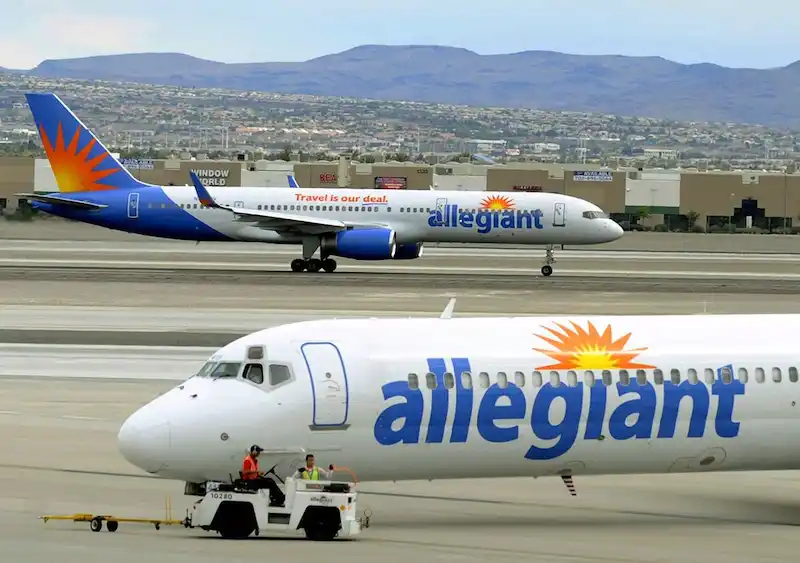


The scorching temperatures sweeping across parts of the United States are presenting challenges for airlines, resulting in adjustments to their operations in the most affected cities. Allegiant Airlines, a unit of Allegiant Travel Co., has stated that it will delay flights if there is a threat to passenger safety or comfort as record-breaking temperatures continue to hit the US Southwest. Las Vegas, where Allegiant is based, has been under excessive heat advisories with temperatures exceeding 100F (38C) since June 30, according to the National Weather Service.
The high temperatures cause the air to become less dense, which reduces engine performance and the amount of lift generated at a given speed. Consequently, aircraft are required to take off with lower weights and longer distances to produce sufficient lift. This necessitates a reduction in the weight of the planes, which can lead to measures such as reducing fuel or baggage and, in some cases, having to remove passengers.
Delta Air Lines recently faced weight issues due to the heat, causing delays on a flight from Las Vegas to Atlanta. As a result, several passengers voluntarily decided to disembark from the aircraft. In response to such situations, additional protocols have been implemented by airlines like Delta to address the operational impact of extreme heat on aircraft. These measures include loading less fuel to account for weight and balance, as well as scheduling refueling along the route when necessary.
To combat the heat-related challenges, planes are connected to external cooling units while at the gates. However, extreme heat can overwhelm these units, reducing their effectiveness. Once the aircraft leaves the gate, air is typically sucked into the engines, cooled, and then circulated in the cabin. However, this system may not work optimally when a plane is idle on a tarmac.
In an effort to ensure cool air on jet bridges, American Airlines is taking extra steps to maintain adequate cooling during the boarding process. The airline has also performed early maintenance on auxiliary power units that run onboard systems when the engines are off. American's CEO, Robert Isom, stated that although they have experienced a small number of diversions and delays due to high temperatures, their plan has allowed them to minimize significant disruptions. The airline has even altered its operating plan to avoid weight restrictions.
Major airlines, including Delta, American, and United Airlines, are taking steps to protect airport staff working outside in extreme heat. This includes providing more frequent breaks, additional water supplies, access to shaded areas or air conditioning, and cooling towels.
The intense heatwave is expected to persist over the weekend in many parts of the US Southwest. Phoenix has already experienced temperatures as high as 119F (48C) and has seen temperatures exceeding 100F since mid-June. In 2017, extreme temperatures forced the cancellation of flights in Phoenix, particularly for smaller regional jets and older aircraft.