




US and European officials are becoming increasingly worried about China's aggressive push into the production of older-generation semiconductors. This has led to discussions about new strategies to contain China's expansion and prevent chips from becoming a point of leverage for the country. President Joe Biden implemented controls over China's access to advanced chips, but Beijing has responded by investing billions into factories for legacy chips that have not been banned. Legacy chips are still critical components used in a wide range of industries, including smartphones, electric vehicles, and military hardware.
These developments have sparked concerns about China's potential influence in the market and the need to restrain the country's dominance. Senior EU and US officials are particularly concerned about China's drive to dominate the legacy chip market, both from an economic and security standpoint. They worry that Chinese companies could flood global markets with these chips in the future, potentially driving foreign competitors out of business, similar to what happened in the solar industry. This, in turn, may lead to Western companies becoming dependent on China for these semiconductors, which could pose national security risks, especially if these chips are needed for defense equipment.
The importance of legacy chips has been highlighted by supply shocks experienced by companies during the height of the Covid pandemic, impacting giants like Apple and carmakers. The shortages cost businesses billions of dollars in lost sales. Simple components such as power management circuits are crucial for products like smartphones, electric vehicles, and military gear like missiles and radar.
While the US and Europe are attempting to strengthen their own domestic chip production to reduce reliance on Asia, domestic producers may be hesitant to invest in facilities that will have to compete with heavily subsidized Chinese plants. The US government, along with its allies, is currently assessing the willingness of Western companies to invest in such projects before determining the appropriate course of action.
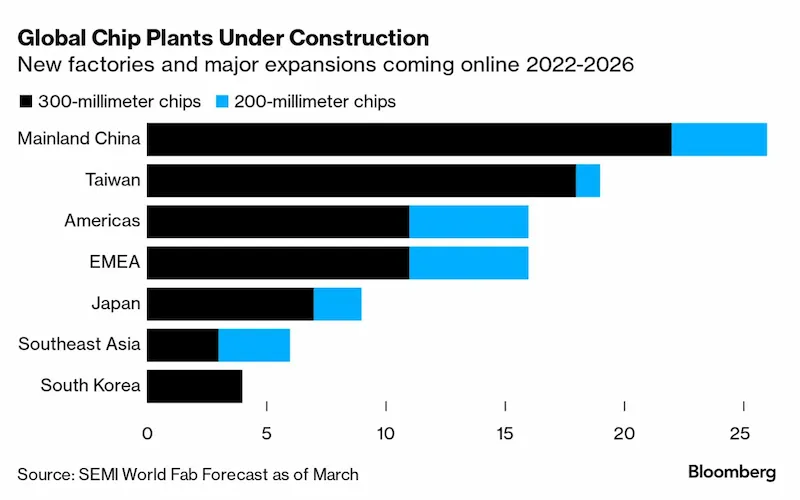
While the US rules implemented last year slowed down China's development of advanced chipmaking capabilities, they did not significantly impact the country's ability to use older techniques. Consequently, Chinese firms have been building new plants at a faster rate than anywhere else in the world. According to trade group SEMI, Chinese companies are projected to construct 26 fabs by 2026 that use 200-millimeter and 300-mm wafers, compared to 16 fabs for the Americas. Despite rising tensions between the US and China, significant investments have enabled Chinese companies to continue supplying chips to the West. Semiconductor Manufacturing International Corp. (SMIC), China's chipmaking leader, received around 20% of its sales last year from US-based clients, including Qualcomm, despite being blacklisted by the US government.
The concern now is that China's dominance in this market could create new dependencies for the US and its partners, compromising their strategic autonomy. The US and its allies need to be vigilant in mitigating any non-market behavior from China's emerging semiconductor firms. However, no timeline has been set for potential actions, and discussions are still underway regarding how to address this issue effectively.