


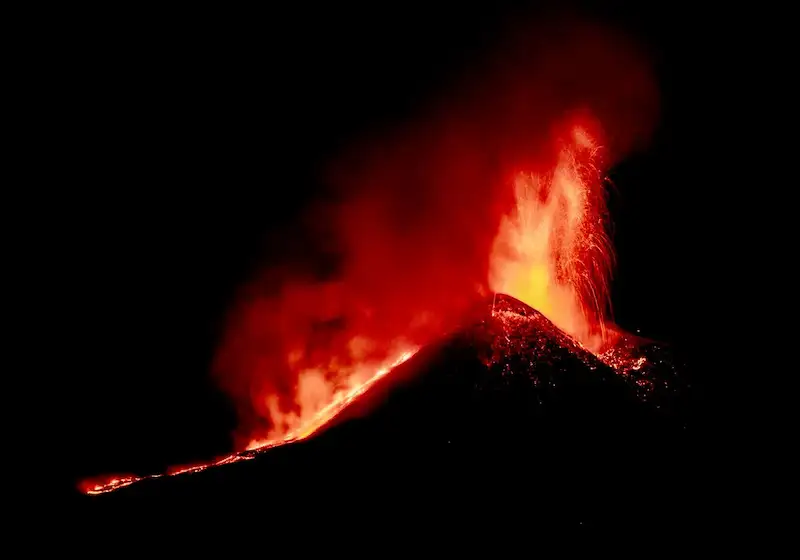


The recent eruption of Mount Etna in Sicily has left travelers stranded and disrupted travel plans in the height of the summer season. Catania Airport, located on the east coast of the island, was forced to close, prohibiting all departures and arrivals until 8 pm local time. This closure also affected the surrounding airspace.
Several airlines, including Ryanair, EasyJet, and Wizz Air, were forced to cancel morning flights to and from Catania. Mount Etna, Europe's most active volcano, erupted during the night at an altitude of approximately 2,700 meters, spewing smoke and ash. The National Institute of Geophysics and Volcanology reported that the volcano's activity was gradually declining.
The presence of ash plumes poses a significant risk to aircraft due to the potential damage it can cause to jet engines. This issue was highlighted in 2010 when the eruption of an Icelandic volcano resulted in the closure of airspace in several European countries and the cancellation of thousands of flights.
Ryanair issued a travel update informing passengers that flights to and from Catania may experience delays, diversions, or cancellations due to the volcanic eruption. Wizz Air also reported delays and cancellations impacting four rotations, with the possibility of further changes if the volcanic activity persists. EasyJet, on their website, announced delayed flights from London to Catania, while British Airways had to cancel a scheduled flight on Monday due to the airport closure.
According to Cirium, an analytics firm, approximately 235 flights were scheduled to depart and arrive at Catania Airport on Monday, making it the sixth busiest airport in Italy.
This is not the first time Catania Airport has faced disruption this summer. In July, flights had to be suspended due to a fire, while heat waves and wildfires ravaged southern Europe.
As the volcanic activity recedes, authorities and airlines will continue to monitor the situation closely, ensuring the safety of travelers while minimizing disruption to their travel plans.