


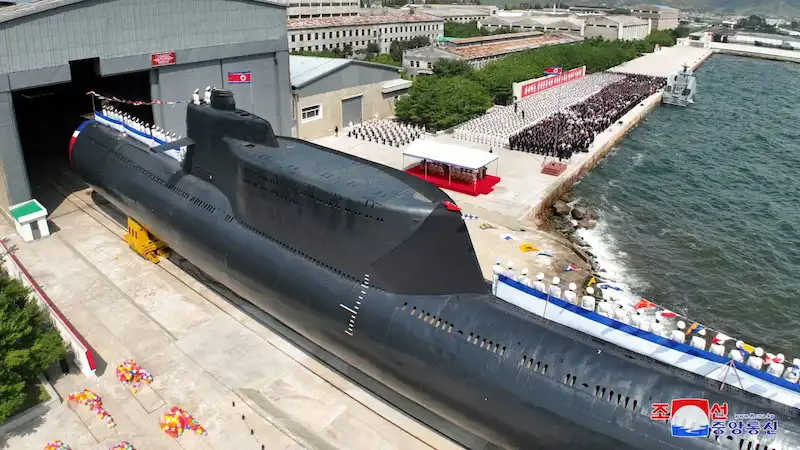


North Korea made headlines with its claim of successfully launching a new "Korean-style" tactical nuclear attack submarine, which the country says marks the beginning of a new era for its naval capabilities. However, experts remain skeptical of North Korea's claims, with South Korean authorities questioning the functionality of the vessel.
The submarine, known as "Hero Kim Kun Ok," was unveiled in a grand ceremony attended by North Korean leader Kim Jong Un. According to the state-run Korean Central News Agency (KCNA), Kim described the submarine as being equipped with numerous nuclear delivery means and capable of preemptive and retaliatory strikes against hostile countries. He also called for the conversion of other medium-sized submarines in the country into nuclear-capable versions.
However, South Korea's Joint Chiefs of Staffs (JCS) dismissed these claims, stating that the new submarine does not appear to be capable of normal operation. They warned that North Korea may be exaggerating its capabilities.
This announcement comes on the heels of North Korea's recent claim of simulating a nuclear missile attack as a warning to the United States of the "nuclear war danger." These actions are seen as a way for North Korea to assert its military prowess and signal its readiness to counter any perceived threats.
Experts in the United States have also expressed doubts regarding the new submarine. While some suggest that it may be conventionally powered but armed with ballistic missiles carrying nuclear warheads, others remain uncertain about its capability to launch such missiles.
Submarine expert H I Sutton suggests that the new vessel appears to be based on the aging Soviet-designed Romeo-class submarines. North Korea is estimated to already possess 20 Romeo-class submarines out of a total fleet of 64 to 86 submarines. The newly launched submarine reportedly features 10 missile launch tubes, potentially indicating its nuclear capabilities based on North Korea's investment in ballistic missiles.
Nevertheless, some analysts cast doubt on the effectiveness of Pyongyang's submarine-launched missiles. They argue that land-based missiles, which are more survivable and cost-effective, are likely to remain the backbone of North Korea's nuclear and missile forces, overshadowing the significance of ballistic missile submarines.
While it is unclear whether the submarine is nuclear-powered or not, Kim Jong Un reiterated his country's plans for future nuclear-powered vessels. His vision is to strengthen and develop North Korea's navy into a world-class maritime force. Regardless of the power source, the launch of this submarine allows Kim to send a deterrent message to adversaries like the United States and Japan, signaling the progress of his nuclear program and the potential for strikes from multiple directions.
The timing of this submarine launch and North Korea's simulated nuclear missile attack coincides with the upcoming 75th anniversary celebration of the country's founding on September 9. These events also reflect North Korea's unease over increased cooperation between the United States and South Korea, as demonstrated by joint military exercises and pledges for enhanced military collaboration. North Korea's heightened missile testing activities this year further underscore its determination to assert its presence on the international stage.