


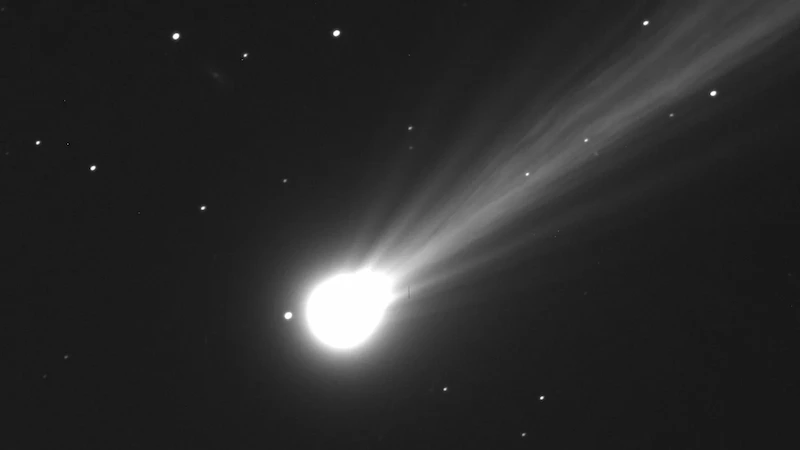


A recently spotted comet, named Comet Nishimura, will soon be making a close pass by Earth, providing sky-gazers with a unique opportunity to witness this celestial event. First observed by Japanese space photographer Hideo Nishimura back in August, the comet has been steadily increasing in brightness as it travels through the inner solar system.
On Tuesday, the comet will make its closest approach to our planet, coming within 78 million miles (125 million kilometers). This means that over the course of the next five days, there is a potential to view the comet from Earth. It will then continue its journey, getting even closer to the sun and passing within 21 million miles (34 million kilometers) of our star on September 17.
Comet Nishimura completes an orbit around the sun every 430 to 440 years, which indicates that the last time it may have gotten close to both the sun and Earth was around 1590, before telescopes were even invented. While it is uncertain whether it was bright enough to be seen with the naked eye back then, the comet's current proximity to our planet offers a rare opportunity to observe its existence.
To catch a glimpse of Comet Nishimura, astronomers suggest using binoculars as it is barely visible due to its distance from Earth and its positioning near the horizon. Optimal viewing conditions include finding a dark area away from city lights. Sky charts provided by sources like Sky and Telescope can assist in locating the comet in the night sky.
One distinguishing characteristic of the comet is that its tail will always point away from the sun, as the sunlight continuously pushes on the fine dust particles surrounding it. While photos may depict Comet Nishimura as greenish due to the presence of diatomic carbon, it will likely appear nearly colorless or slightly pink when observed through binoculars, as sunlight reflects off the tiny dust grains.
For those living in the Northern Hemisphere, it is recommended to seek a clear view of the east-northeast horizon approximately half an hour before morning twilight. However, it should be noted that observing this comet will not be easy, especially for those who have not observed comets before. As each day passes, the time window for viewing the comet becomes narrower, and it progressively lowers on the horizon.
After passing between Earth and the sun on Wednesday, the comet will become even more challenging to observe. It may potentially become accessible in the evening sky a few days later, but it will likely be overshadowed by bright twilight and could remain invisible unless it significantly brightens.
The intense heat from its close approach to the sun poses a threat to Comet Nishimura's survival. As its frozen ices heat up and transform into gases, there is a possibility that the comet may break apart. However, experts anticipate that it will survive, as it has likely endured similar close encounters in the past. If it does survive the sun's intense heat, the comet will pass over to the far side of the sun in early October and then reemerge into the morning sky of the Southern Hemisphere in November. It may remain visible for several months thereafter, gradually fading as it moves away from the sun and Earth.
Unfortunately, if you happen to miss the opportunity to observe Comet Nishimura, there are several other comets expected to appear in the night sky over the next 16 months. Comet Pons-Brooks will make its closest approach to the sun in April and could be faintly visible to the naked eye in the evening sky. In June, Comet Olbers will closely approach the sun and can be observed with binoculars. Additionally, Comet Tsuchinshan-ATLAS, discovered in January, will be closest to the sun in late September 2024 and will swing by Earth in mid-October 2024, with the potential to become exceptionally bright.