


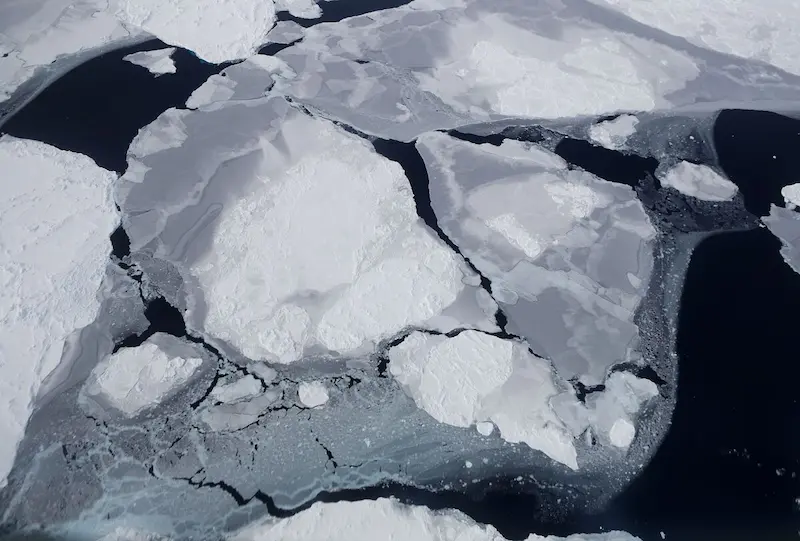


A new study has unveiled that the West Antarctic ice sheet is poised to melt at an accelerated rate, even if the world takes urgent measures to cut emissions. This alarming revelation suggests that the melting could result in substantial sea level rise over the span of centuries, significantly impacting coastal regions around the globe.
The West Antarctic ice sheet currently holds a staggering 3.2 million cubic kilometers (767,000 cubic miles) of ice on land. Despite its immense size, it is experiencing the most rapid melting among all regions in Antarctica, making it the largest contributor to rising sea levels.
Published in Nature Climate Change, the study offers a revised estimate by examining the risks posed to the floating ice shelves at different levels of global warming. These massive shelves act as barriers, preventing the ice sheets on land from sliding into the ocean. However, mounting research suggests that warmer ocean temperatures are destabilizing the ice shelves around West Antarctica, heightening concerns about substantial sea level rise.
The researchers employed a regional ocean model to simulate four possible global warming scenarios. These scenarios ranged from a future marked by high fossil fuel usage to one where global temperature rise is limited to 1.5°C by 2100, as outlined in the Paris Agreement. In all the simulated scenarios, warming oceans resulted in significant and extensive melting of the ice shelves from below.
Shockingly, the study revealed that reducing greenhouse gas emissions had minimal impact on stemming the acceleration of melting. Consequently, without the protective presence of the ice shelves, larger portions of the West Antarctic Ice Sheet are likely to collapse into the ocean. The associated sea level rise would have catastrophic consequences, warns Lettie Roach, an associate research scientist at Columbia University who was not involved in the study. According to the study, the ice sheet contains enough water to raise the global mean sea level by a staggering 5.3 meters (17.4 feet).
Roach further adds that the potential consequences of such sea level rise are dire, with hundreds of millions of people at risk of annual flooding and trillions of dollars of infrastructure damage. These events would have a substantial impact on global GDP.
However, there are certain uncertainties to consider. The Antarctic climate is an intricate system, and models cannot fully capture its complexities. Roach explains that comprehensively representing the region is a challenge, given the interplay of multiple factors, including the atmosphere, ocean, sea ice, ice shelves, and ice sheet.
Scientists are still working to refine estimates regarding the speed at which the ice shelves will melt and how this will affect the land-based ice. As Kaitlin Naughten, lead author of the study and oceanographer at the British Antarctic Survey, explains, predicting exact response times is difficult. While the bulk of the ice sheet's reaction is anticipated to take several centuries, it does not respond instantaneously.
While the study's findings may paint a concerning picture, they do not imply that efforts to reduce emissions should be abandoned. Even if immediate reductions may not halt the melting, researchers predict that more ambitious mitigation scenarios could slow the rate of melting after 2100. This would provide additional time for adaptation to sea level rise. Additionally, curbing greenhouse gas emissions can help mitigate the melting of other ice sheets, including the significantly larger East Antarctic ice sheet, which has the potential to cause ten times more sea level rise.
Naughten emphasizes that despite the gravity of the situation, it is crucial to maintain perspective and continue addressing the broader impacts of climate change. She states, "There are so many other impacts of climate change, which we can still stop. We have to keep this in perspective."