


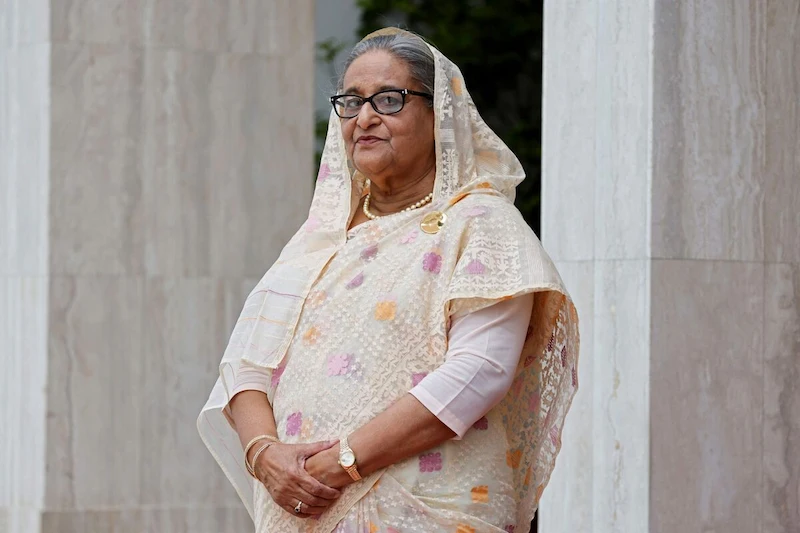


Protests erupted in Bangladesh's capital, Dhaka, as scores of opposition supporters clashed with police and renewed their demand for Prime Minister Sheikh Hasina to resign ahead of next year's elections. The calls for resignation came from the Bangladesh Nationalist Party (BNP), the country's largest opposition group, which organized a peaceful rally to pressure Hasina, 76, to step aside in favor of a non-partisan caretaker government. The government, however, rejected the demand, citing the country's top court ruling that the caretaker system is illegal.
Tensions escalated as opposition activists clashed with police near the protest venue. Videos shared on social media showed police using tear gas shells to disperse the crowd, while armored vehicles patrolled the area. To ensure security, the government deployed paramilitary troops to assist the police. In addition to the BNP rally, the Islamist group Bangladesh Jamaat-e-Islami breached police barricades to hold a separate anti-government gathering. The BNP also plans to enforce a nationwide shutdown, known as hartal, on Sunday to condemn the perceived police crackdown on the opposition.
These clashes pose a significant challenge to the government, which recently gained initial approval from the International Monetary Fund (IMF) to access more funds from a $4.7 billion loan package to stabilize the economy. The Hasina administration has faced criticism over its handling of elections, with intermittent crackdowns on dissent. The ruling Bangladesh Awami League has organized another rally on the same day to counter the opposition. This ongoing confrontation has intensified tensions in Dhaka and other major cities, with rival parties holding frequent rallies.
In connection with the protests, the police have reportedly arrested at least 1,680 BNP supporters over four days, according to Ruhul Kabir Rizvi Ahmed, the BNP's senior joint secretary-general. Moreover, the potential for violence looms as the general secretary of the Awami League, Obaidul Quader, warned of a counter-attack if the opposition were to attack their peaceful rally.
The United States has exerted pressure on Hasina's government by imposing visa restrictions on individuals perceived to undermine democracy in Bangladesh. In 2021, the US also sanctioned the Rapid Action Battalion, a police unit accused of human rights abuses, including extra-judicial killings. While Bangladesh has vowed to ensure free and fair elections following these restrictions, Hasina accused the US of bias against her government in a May interview with the BBC. Furthermore, concerns have been raised by the International Republican Institute and the National Democratic Institute, based in Washington, regarding the upcoming elections. They have warned about a climate of uncertainty, fear, uncompromising politics, and political violence during their visit to Dhaka earlier this month.
As Bangladesh seeks to diversify its economy away from the garment industry, which heavily relies on demand from Europe and the US, Hasina's government has been strengthening ties with India and China. However, with protests intensifying and election-related tensions escalating, the focus is now on addressing the demands of the opposition and ensuring a peaceful and inclusive electoral process.