


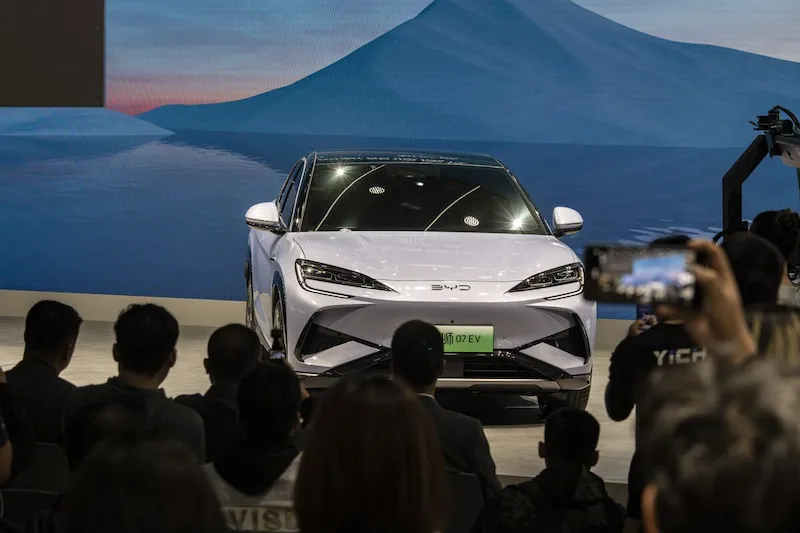


BYD, Xpeng, and Li Auto took center stage at this year's Auto Guangzhou, one of China's biggest car shows, by unveiling their highly anticipated electric SUVs. The event, which began on November 17 and will continue until November 26, attracted crowds eager to see the latest offerings from leading electric vehicle manufacturers. With an emphasis on appealing to tech-savvy consumers who prioritize environmental consciousness, the exhibition showcased a range of sport utility and multi-purpose vehicles.
BYD, one of China's top car brands, presented the Sea Lion 07, its answer to Tesla's popular Model Y. The Sea Lion 07 is BYD's first mid-size battery-electric SUV, signaling the company's ambition to surpass Tesla as the world's largest producer of pure electric vehicles. Equipped with BYD's proprietary DiSus body control system, the Sea Lion 07 offers superior driving capabilities in various conditions. With an expected price range of 200,000 yuan to 260,000 yuan ($27,700 to $36,000), the Sea Lion 07 aims to provide a more affordable alternative to the base model of the Model Y, currently priced at 266,400 yuan in China.
Li Auto, known for its popular extended-range electric vehicles, finally unveiled its first pure-electric model at the exhibition. The seven-seat Mega MPV garnered an impressive 10,000 pre-orders within just two hours of its release. The design of the MPV drew significant attention, with its sleek and uninterrupted windscreen and roof, contributing to improved aerodynamics and extended driving range. Powered by Contemporary Amperex Technology Co. Ltd.'s Qilin battery, which offers a range of 1,000 kilometers (621 miles), the Mega MPV can charge up to 500 kilometers in just 12 minutes. With a starting price under 600,000 yuan, mass production and deliveries are expected to commence in February.
Geely Automotive Holdings Ltd.'s premium Zeekr brand introduced its first electric sedan, the 007. Designed by a team led by Audi veteran Stefan Sielaff, the futuristic-looking car boasts clean lines, featuring no door handles, and a 90-inch intelligent lighting display on the front bumper. The all-wheel-drive version of the 007 offers an impressive 475 kilowatts of power, propelling the car from zero to 100 kilometers per hour in just 2.84 seconds. Inside, a tilting central console display adds to the futuristic experience, while special seats and a heads-up display enhance the sportier version. With two available ranges of 688 kilometers and 870 kilometers, and fast-charging capabilities of up to 610 kilometers in 15 minutes, the 007 received 20,000 pre-orders within the first 48 hours. Deliveries are expected to begin in January, with discounted pre-sales prices starting at 224,900 yuan.
Xpeng, which recently partnered with Volkswagen to develop EVs, introduced its first pure-electric MPV, a seven-seater designed for the family market. Priced at 388,000 yuan, the flagship model offers a range of 610 kilometers on a single charge, marking a significant step forward for Xpeng as it expands beyond the mass market. The interior focuses on comfort and entertainment, featuring a 21.4-inch entertainment screen, an integrated fridge, and ample storage space. Additionally, Xpeng's automated driving features will be implemented in this model.
Cadillac, one of the few foreign carmakers at the exhibition, launched its Optiq electric SUV, specifically designed for the Chinese market. Positioned as a rival to Tesla's Model Y, the Optiq offers a range of 502 kilometers. While pricing details have yet to be announced, it is expected to be smaller and more affordable than Cadillac's Lyriq SUV. Cadillac, along with its parent company General Motors, aims to regain market share in China by catering to consumers' increasing preference for electric vehicles.
Lastly, Changan Automobile Co. showcased its Lieshou, meaning "hunter" in Chinese, a standout amidst the sea of sedans and SUVs at the exhibition. While pickup trucks are not particularly popular in China due to entry restrictions in some cities, recent developments lifting the bans have created new opportunities for electric and hybrid models in the market. The Lieshou is designed as an extended-range electric vehicle with a remarkable range of up to 1,031 kilometers. With a pure electric range of 170 kilometers and a fuel consumption rate of approximately 1.9 liters per 100 kilometers, the Lieshou offers a more fuel-efficient option compared to traditional gasoline cars, which consume 6 to 7 liters per 100 kilometers.
As the year-end approaches, automakers are intensifying their efforts to generate buzz and boost sales to meet annual delivery targets. Despite the cooling of China's auto market, the push to capture headlines with new vehicle launches remains evident at this year's Auto Guangzhou, where electric SUVs claimed the spotlight and captured the attention of prospective buyers.