


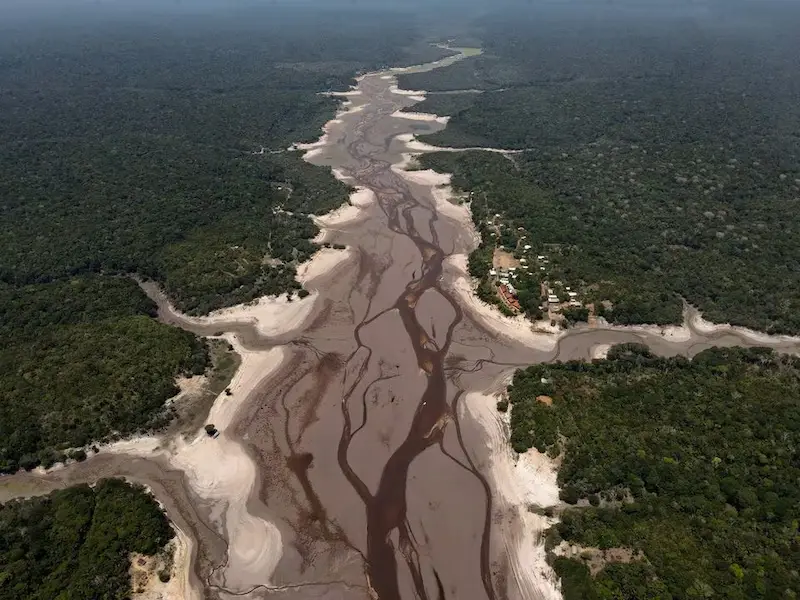


In a groundbreaking study published in the journal Nature, scientists have issued a dire warning about the future of the Amazon rainforest. They assert that climate change, deforestation, and an increase in fires are pushing nearly half of the Amazon rainforest towards a tipping point, threatening its collapse by 2050.
The researchers state that the region is facing unprecedented stress due to rising temperatures, extreme droughts, deforestation, and rampant fires, even in previously untouched parts of the ecosystem. Their analysis suggests that between 10% and 47% of the current forest cover could succumb to these combined stressors within the next three decades.
Lead author of the report, ecologist Bernardo Flores from the University of Santa Catarina in Brazil, warns that once this tipping point is crossed, there may be no way to save the forest. "The forest will die by itself," Flores says, emphasizing the urgent need to declare a "red alert" for the Amazon.
As temperatures soar and moisture levels decline, the rainforest is gradually transforming into savannah and other degraded ecosystems that are more prone to wildfires. This represents a significant shift for the Amazon, where fires are typically ignited by ranchers or farmers clearing land. However, as the land becomes drier, the risk of wildfires increases, resembling the situation in the parched pine forests of the western United States and Canada.
To assess the potential outcomes, the researchers examined various factors, including climate patterns, human influence, forest fragmentation, and land management. Flores explains that their objective was to assemble all the puzzle pieces and understand the significance of each factor in the larger picture.
While the study acknowledges some uncertainty in its projections, it highlights a clear trend: the Amazon ecosystem is on the brink of a dramatic transformation. Apart from the potential savannization of vast areas, the researchers also mention the expansion of degraded forest or the dominance of fire-tolerant species in open-canopy ecosystems as alternative outcomes. However, all of these scenarios are interconnected and have significant implications for biodiversity loss.
Marina Hirota, co-author of the study and researcher at Brazil's University of Santa Catarina, warns that these changes would be catastrophic for Indigenous communities and others who depend on the forest for their livelihoods. For them, the loss of the Amazon would mean the loss of everything.
The urgency of the situation has not gone unnoticed by Brazilian authorities. Last year, Environment Minister Marina Silva emphasized the need for a global effort on par with the post-World War Two Marshall Plan to save the Amazon.
Renowned climate scientist Carlos Nobre from Brazil's University of Sao Paulo commends the new research, stating that it underscores the proximity of the Amazon rainforest to a tipping point. Deforestation exacerbates the risk by reducing the number of trees that generate the moisture necessary to sustain the forest. Currently, approximately 18% of the Amazon rainforest has already been destroyed, and if that figure reaches 20-25%, there is a high probability of the entire forest transitioning to savannah.
While the study presents a wide range of potential outcomes, ecologist Nicola Clerici from Colombia's Universidad del Rosario emphasizes the need for further research to increase scientific certainty. He stresses the importance of placing this research topic on the global agenda, highlighting the urgent need to address the impending collapse of the Amazon rainforest.