


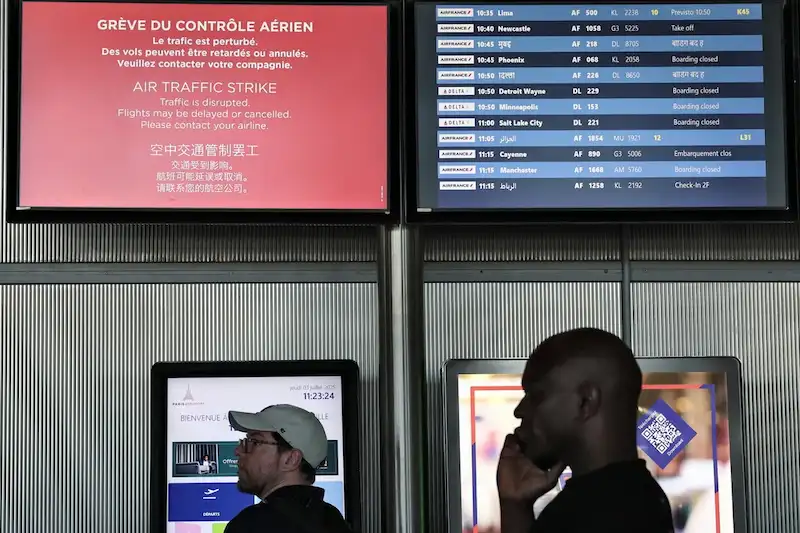


Travelers across Europe are facing a fresh wave of flight cancellations and delays as a widespread strike by French air traffic controllers entered its second day, sending ripples through the continent’s air travel network at the height of summer getaway season.
If you were hoping to start your vacation with a smooth check-in and a window seat to the clouds, you might want to sit down: by mid-Friday, a total of 658 outgoing flights and 645 arrivals in France had been canceled. That’s not a typo—it’s nearly double the already-high numbers from the previous day. Airports from Paris to Marseille are seeing long queues, confused announcements, and frustrated travelers clutching their phones trying to rebook.
For Ryanair, the low-cost carrier that moves millions of people around Europe each year, the disruption has been nothing short of a logistical nightmare. Over 400 of its scheduled flights were scrapped, and the airline isn’t being quiet about it. CEO Michael O’Leary didn’t mince words, calling the reason behind the strike “bizarre” and aimed squarely at what controllers describe as “short staffing.”
“The idea that they’re striking because there aren’t enough of them is absurd,” O’Leary said, clearly exasperated. “If you want better staffing, don’t walk out—you show up.” He’s now publicly pressuring the European Commission to step in and overhaul the system, which many in the industry say has been hanging by a thread since the COVID-19 pandemic upended the aviation world.
That "thread" is fraying fast. Staffing issues in European air traffic control towers have lingered for years, worsened by retirements and hiring freezes. So, when a portion of the staff calls out—or in this case, walks out—the whole structure starts to collapse. Flights are delayed not just in and out of France but across neighboring countries that rely on French airspace.
EasyJet, another major player in European skies, has also been heavily impacted. On Thursday alone, it canceled 124 flights. On Friday, that number climbed to 150. The airline’s top executive, Kenton Jarvis, echoed Ryanair’s frustration, calling on French authorities to protect the integrity of Europe’s air routes.
"This is not just about France," Jarvis said. "Flights that merely pass over the country—without landing—are getting caught in the fallout. That shouldn’t happen."
And here’s the irony: many of the passengers affected by the strike aren’t even flying to France. Due to the country’s central position in Europe, a huge number of flights must cross through its airspace. So even if your trip was just from Amsterdam to Barcelona, you're not immune.
In the terminals, travelers face a confusing mess. Departure boards flash red with cancellations, while airline staff, many of whom are just as worn out as the passengers, do their best to redirect and rebook. Some people have opted to take trains, buses, or even rent cars—anything to keep moving. Others are simply giving up and heading home, vacation dreams on pause.
There’s no word yet on whether more strike days are coming, but with tensions high and the summer just beginning, many in the industry are bracing for more turbulence. As airlines juggle rerouting and refunds, and airports struggle to handle the backlog, one thing is clear: Europe’s travel network is under pressure, and the cracks are showing.
If you're planning to fly soon, check your status early and often—and maybe pack a little extra patience. You’ll probably need it.