


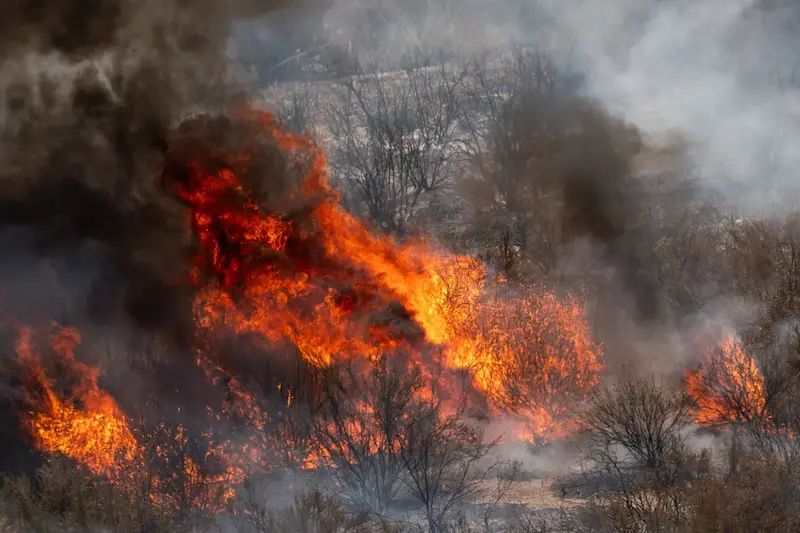


The western half of the United States is bracing for a rough stretch ahead — wildfires, heat, storms — all jostling for attention in the same week. The land feels restless, as if summer is winding up for one more push before letting go.
Out in California, the Gifford Fire has been chewing through countryside about 125 miles northwest of Los Angeles. As of Saturday, more than 113,000 acres had gone up in smoke. Crews have managed to get a handle on about a fifth of it, but it’s far from over. Over eight hundred people have been forced to leave their homes, and Los Padres National Forest is now completely closed off. Almost four thousand firefighters and support workers are in the field, working in punishing heat and dangerous conditions. At least seven have been hurt so far. Cal Fire says this blaze is the biggest of 14 currently burning across the state.
Colorado isn’t faring much better. Fires there have choked the air, pushing quality levels down enough for the National Weather Service to post alerts across the western side of the state — including around Vail. Even farther afield, the smoke trail from Canada’s persistent fires has once again drifted south, painting hazy skies over Minnesota and Wisconsin and prompting air quality warnings. Northeast Montana is under a dense smoke advisory, while in Canada, parts of Saskatchewan and Manitoba are also on alert.
Canada’s wildfire season remains brutal: 714 active fires, 166 of them out of control. Since the start of the year, 4,277 blazes have burned through about 7.3 million acres. In the United States, fire numbers are actually higher than last year — over 42,800 so far — but total acreage burned, about 3.5 million, is still lower than the 5 million that went up in flames by this time in 2023.
Heat is pressing in too. Large patches of the West, from California through Idaho, are under excessive heat warnings or advisories. Phoenix is expected to top out at 108°F on Sunday, which actually counts as a “cool-down” after last week’s blistering stretch that included a record-breaking August day of 118°F. Nevada, Arizona, Oregon, and Washington are also staring down another round of intense heat.
The heat isn’t staying in the West. The Northeast is about to feel it as well. In New York City and surrounding areas, thermometers will climb, and forecasters think a dozen temperature records could fall in the coming days. Meanwhile, the Midwest has its own troubles. Heavy rain has triggered flood watches, with Milwaukee seeing its river in Estabrook Park surge more than eight feet in just one day, cresting at a record 11.19 feet.
Far out in the Atlantic, the National Hurricane Center is keeping tabs on two possible storms. One is a scattered cluster of thunderstorms, not looking especially organized yet, but with a 20% chance of turning into something more in the next week. The other is a broad low-pressure system rolling off the African coast — that one has a much higher 70% chance of becoming a tropical storm or even a hurricane before the week is over.
Across the ocean, Tropical Storm Dexter has already run its course across the Atlantic toward Europe. What’s left of it will help pump warmer air into the UK and Ireland, and forecasters say London could be basking in 33°C (91°F) heat by Tuesday — a late-summer twist that will have more than a few people double-checking their thermometers.
It’s one of those weeks when nature seems determined to remind everyone just how many ways it can make headlines — fire, heat, wind, and water all at once.