


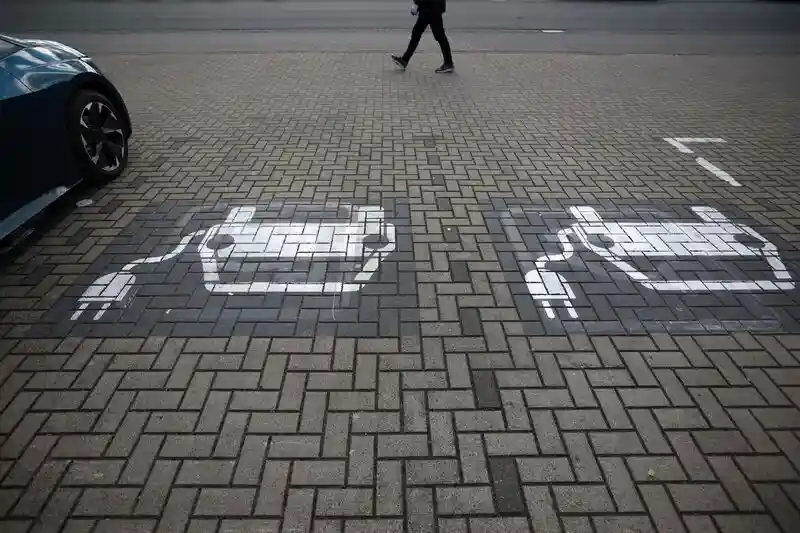


The German government has quietly dropped its goal of setting up one million electric car charging stations in streets and supermarkets by 2030. The target, initially set in 2021, was part of the ruling coalition’s treaty and was intended to encourage the uptake of electric vehicles (EVs) in the country. However, the government has now recognized that more people are switching to home-based charging, making the target redundant.
Despite the government’s official policy, officials have confirmed that they will no longer pursue the one million charging points goal, according to several sources. This shift highlights the challenge that European countries face in developing public infrastructure to encourage EV usage. Even as Germany boasts of about 85,000 publicly accessible charging stations and almost a fifth of those classified as fast charging points, drivers are quickly embracing the option of installing private chargers at home.
Germany’s VDA car lobby had initially pushed for the goal in the master plan back in October, arguing that the broader charging network would benefit the country’s car industry. However, even a 2020 study, involving the automotive industry, energy sector, science, and politics, only showed the need for one million charging points in one out of the four scenarios it assessed. The report noted that the other three scenarios required far less charging infrastructure.
Germany’s economy ministry declined to comment on the shift, referring to the transport ministry, which insisted that the government was still committed to the coalition agreement. The transport minister, Volker Wissing, is reportedly pushing for policies that favor automakers’ interests, with the industry seeking wider expansion of charging infrastructure across Europe to boost EV sales.
While a broader network of charging infrastructure could become useful as the prices of EVs decline and the number of EV owners without private charging options grows, experts predict that Germany will need around 450,000 charging points by decade-end. Even a separate, independent study from 2020 projected that Germany probably needs only between 440,000 to 843,000 public charging points, with the upper end being more feasible under slow private uptake.
In conclusion, while Germany may still officially have the goal of one million public charging points for EVs by 2030, it appears that the authorities have accepted that the focus will need to shift to home charging stations. However, this could still change, depending on technological advancements and consumer trends.