


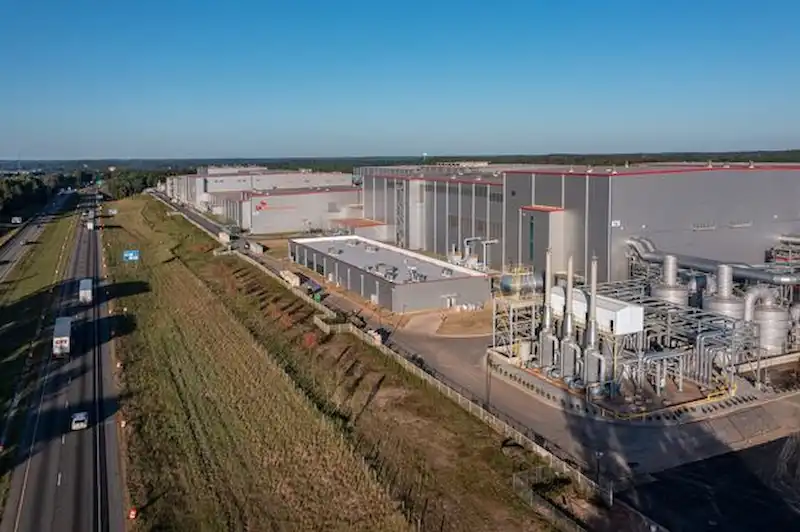


South Korean battery maker, SK On Co., is undeterred by its current financial losses, as it remains focused on investing in its future growth. Despite facing losses throughout the year, SK On Co. is confident that its expansion strategies will pay off in the long run. The company, which received a conditional commitment for a $9.2 billion loan from the US government to build three electric-car battery plants in America, views these losses as a necessary part of the production cycle. CFO Kyung-hun Kim stated, "Once we are about to see a small profit, we should build another plant, and we have a loss again."
Although SK On Co. may be operating at a loss, it is witnessing a significant surge in sales, solidifying its position in the American EV market. Currently, the company has two plants in Georgia and plans to establish another joint venture with Hyundai Motor Co. in the state. Furthermore, it has partnered with Ford to build three additional plants in Kentucky and Tennessee, using funds provided by the Biden administration. This growth is expected to lead to a doubling of revenue, reaching approximately 14 trillion won ($10.7 billion) this year.
The loan received by BlueOval SK, a joint venture between Ford and SK On, from the US government is the largest ever offered to an automaker since the 2009 bailouts. This financial support mitigated investor concerns regarding the feasibility of producing electric batteries at such a large scale. The loan has also allowed Ford to commit to manufacturing 2 million EVs by 2026. Obtaining this loan was a rigorous process, involving extensive scrutiny by US authorities of SK On's finances, technology, and expected market impact. The commitment from both companies to job creation greatly appealed to the US government.
While the injection of funds has resolved liquidity concerns for SK On Co., the company still faces the challenge of improving its profitability. In the first quarter, the company reported a loss of 344.7 billion won, while its local peers LG Energy Solution Ltd. and Samsung SDI Co. achieved strong profits. Kim expects SK On Co. to achieve profitability by 2024, but profitability remains a key concern for the company.
To address the profitability issue, SK On Co.'s CFO, Kyung-hun Kim, brings his expertise as a former investment banker to the table. He is optimistic about leveraging the tax credits provided by President Biden's Inflation Reduction Act to enhance the company's financial performance. Discussions are ongoing regarding when SK On Co. will reflect these tax credits in its earnings, following the example of rival LG Energy, which incorporated the credits in its second-quarter results.
However, SK On Co. faces additional challenges in rebuilding manufacturing in the US, a country that has outsourced much of its production to cheaper overseas locations. Rising inflation and the demand for highly skilled labor, coupled with a shortage of battery engineers, exacerbate this issue. The company acknowledges that educating the local workforce will be essential, as many communities where the new plants are being constructed lack a skilled manufacturing workforce.
Another factor that could impact SK On Co.'s profitability is the popularity of its batteries, particularly in Ford's EVs. The company's competitive advantage lies in its high-nickel batteries that maximize driving range. However, there is also a risk associated with being heavily dependent on a few customers, such as Ford. If Ford's EVs do not perform as expected, it may lead to an inventory backlog of batteries at SK On Co.'s plants.
After enduring several quarters of losses and a legal settlement with LG Energy that raised questions about the quality of its technology, SK On Co. has a lot to prove to investors and industry observers. The company is ramping up production significantly, but experts believe it will take about four to five years to achieve consistent results. Despite this, CFO Kim remains determined and emphasizes the importance of maintaining product quality, even if it means moving at a slower pace than expected.
SK On Co. plans to pursue an initial public offering (IPO) within the next four years, with the possibility of an earlier IPO depending on market conditions and the company's profitability. As it works towards this goal, SK On Co. continues to prioritize its expansion in the US, confident in the potential of the American EV market and its partnership with Ford.