


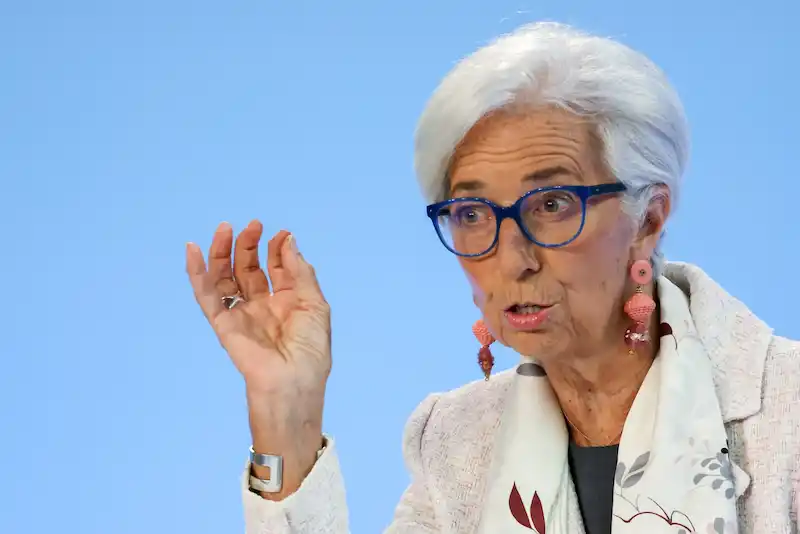


Christine Lagarde, the president of the European Central Bank (ECB), delivered a somewhat bleak assessment of the euro-zone economy as she announced the ninth consecutive interest-rate increase. Lagarde acknowledged that the economic outlook has deteriorated and indicated that the Governing Council is open to the possibility of another rate hike in September. In contrast to the Federal Reserve's optimistic view that the US economy may avoid a downturn, ECB officials are expressing a more cautious tone as they increasingly recognize the impact of their policy actions on economic activity.
The severity of the growth impact is now a key consideration for ECB policymakers as they weigh the need for further tightening to control inflation. Some analysts believe that if weak survey data, coupled with ambiguous signals on inflation, emerge at the end of August, the ECB may consider pausing further rate increases. However, the expectation remains that there will be an additional interest rate hike to 4% in September, although it is a close call.
The ECB's decision aligns its policy settings with those of the US Federal Reserve, which recently implemented a data-dependent framework for determining whether additional rate hikes are needed. However, the economic situations faced by each central bank are markedly different. Just prior to Lagarde's remarks, US growth numbers exceeded economists' expectations by a considerable margin, further highlighting the divergence between the euro zone and the US.
Following the ECB announcement, the euro weakened nearly 1% against the dollar, marking its largest drop since March. This decline was compounded by the robust US economic data and Lagarde's warnings regarding the near-term outlook for the European economy. Lagarde particularly mentioned the worsening economic conditions, largely due to weakened domestic demand.
The euro has now pared back almost 2% from its peak earlier this month, ending what had been a spectacular rally that propelled it from below parity to its strongest level against the dollar in almost a year. Neil Mehta, a portfolio manager at RBC BlueBay, suggests that the euro is now vulnerable to a reversal, especially against the backdrop of a US economy showing little sign of slowing down. This divergence is also evident in the rates market, where the spread between 10-year US and German government bonds has reached its widest level since December.
Lagarde's comments come on the heels of recent survey data pointing to a diminishing momentum in the service sector, coupled with an ongoing manufacturing slump within the euro zone. The Purchasing Managers' Index for the region has been below the 50 threshold indicating growth for two consecutive months. July's reading was the lowest since November, surpassing economists' estimates.
The economic weakness is centered in Germany, the largest economy in the euro zone, which is grappling with an energy crisis, declining Chinese demand, and higher interest rates, all of which are significantly impacting its industrial sector. Moreover, demand for loans among companies in the wider euro region plummeted in the second quarter, according to a recent ECB report.
"They've seen that the transmission of monetary tightening is serious," says Bruno Cavalier, Chief Economist at Oddo BHF SCA. "They can no longer doubt that their actions will have a restraining impact on demand and prices."
Unfortunately, the timing of the ECB's decision occurred just three working days before the release of the latest euro-zone inflation and growth numbers, which provide hard data as opposed to sentiment and survey reports. While it is possible that the GDP statistics for the second quarter may reveal a boost from increased tourism in Southern Europe, Germany's continued recession is a real possibility. The outlook for the current quarter also appears gloomy, as acknowledged by ECB officials.
Former ECB Chief Economist Peter Praet states that the GDP data is not promising, and he does not anticipate a recovery in the current quarter. It is evident that the ECB policymakers see growth risks pointing downwards while evaluating inflation risks as balanced, according to sources familiar with the discussions. Policymakers are anxiously awaiting the new inflation numbers on Monday to determine if further measures are necessary to rein in inflation. Both headline consumer price growth and underlying measures remain above the ECB's target of 2%, at over 5%.
"Economic activity can be collateral damage," warns Jesus Castillo, a eurozone economist at Natixis. "Activity would have to really deteriorate enormously before they start to revisit their monetary policy."