


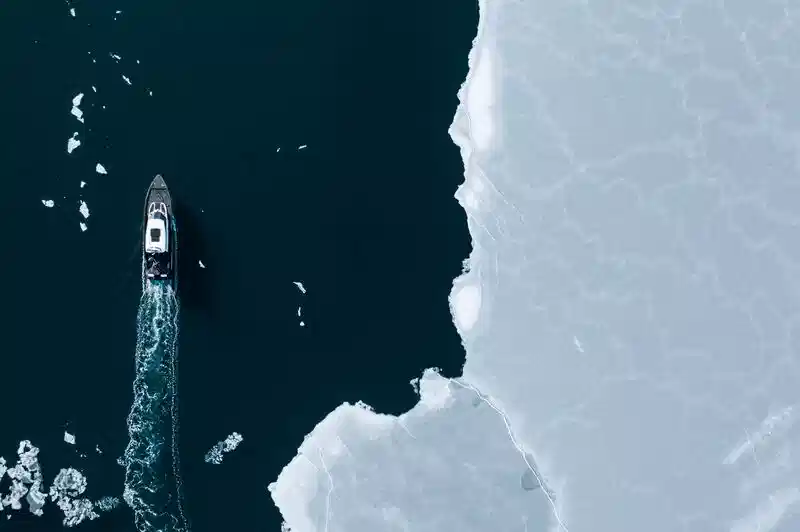


According to the National Snow & Ice Data Center at the University of Colorado Boulder, the Arctic sea ice peaked at 5.64 million square miles this year in early March, which is almost 400,000 square miles less than the median coverage level at other March peaks between 1981 and 2010. This reduction is equivalent to an area larger than Egypt. This year’s maximum extent of Arctic ice was the fifth lowest since satellite records began in 1979, and the average ice extent for the entire month of March has shrunk by an average of 15,000 square miles a year, resulting in a loss of 880,000 square miles since 1979.
The Arctic winter ice usually covers the greatest expanse of ocean in March, after which it slowly melts over the spring and summer months, shrinking to its smallest area, or minimum extent, in September. The lowest peak coverage of Arctic ice was recorded in 2017 when the ice extended over just 5.56 million square miles before beginning to shrink. Since that year, five of the lowest maximum extents have occurred, and the ten lowest coverage years have all taken place since 2006.
According to Mark Serreze, director of the National Snow & Ice Data Center at the University of Colorado Boulder, the Barents Sea region on the Atlantic Ocean side of the Arctic Ocean is experiencing the most significant amount of Arctic warming. Although the exact causes are still being studied, it appears that warm water from the Atlantic is contributing to the ice melt, in addition to the impact of a warming atmosphere. The broader trend is clearly one of less ice, with this year's maximum extent being the fifth-lowest since satellite records began in 1979.
The loss of Arctic ice has cascading effects, including changing weather patterns in the rest of the world, with the planet attempting to equalize temperature differences between higher and lower latitudes. The warming of the Arctic changes that temperature gradient, affecting coastlines, sea mammals, and the livelihoods of Indigenous communities. The impact of summer weather patterns is unpredictable, and it remains to be seen how much ice will be lost by September.