




NASA has successfully landed an asteroid sample on Earth, marking a historic achievement and providing scientists with invaluable insights into the origins of our solar system. The OSIRIS-REx spacecraft, which stands for Origins, Spectral Interpretation, Resource Identification, Security, Regolith Explorer, embarked on its mission in 2016 and has spent the past seven years collecting data and samples from the near-Earth asteroid Bennu.
After orbiting Bennu for two years, the spacecraft gathered a pristine sample of rocks and soil in 2020. In May 2021, it began its long journey back to Earth, covering a staggering distance of 3.86 billion miles. On Sunday, the spacecraft dropped the sample capsule from a distance of 63,000 miles above Earth's surface, entering the planet's atmosphere at incredible speeds of around 27,650 miles per hour.
The capsule, containing approximately 8.8 ounces of asteroid material, deployed parachutes to slow its descent and landed gently at a speed of 11 miles per hour in Utah's Test and Training Range. NASA Administrator Bill Nelson congratulated the OSIRIS-REx team on their remarkable achievement, emphasizing the mission's groundbreaking nature and its ability to inspire and unite people.
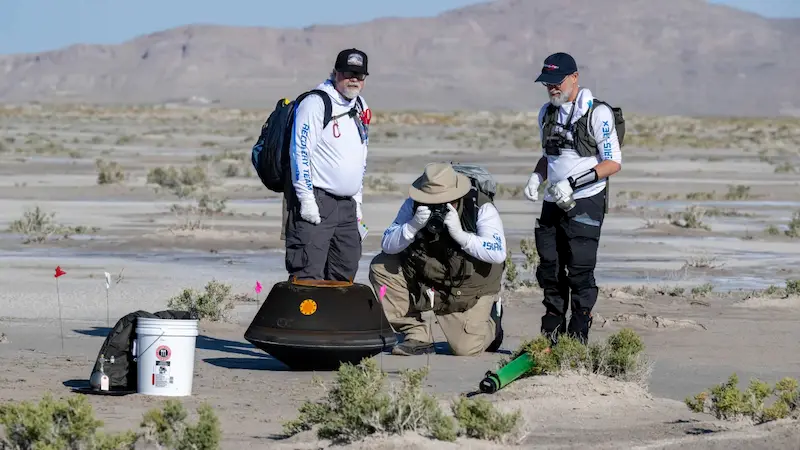
Following the landing, recovery and research teams were dispatched to assess the condition of the sample capsule. Thankfully, it remained intact and was retrieved without any damage. The recovery team, equipped with protective gear, ensured that the capsule had cooled down to a safe temperature before handling it. Their thorough assessment confirmed that the capsule had not been breached during reentry.
In addition to retrieving the sample, scientists collected various air, dust, and dirt particles from the landing site to prevent any potential contamination of the pristine sample. The collected materials will be analyzed and documented to ensure the purity of the sample.
The sample was then transported to a temporary clean room, where a nitrogen purge was performed to remove any traces of Earth's atmosphere and minimize the risk of contamination. The larger pieces of the capsule will be removed, allowing scientists to finally see the sample inside. On Tuesday, scientists at NASA's Johnson Space Center in Houston will have their first opportunity to examine and analyze the sample.
The analysis of the asteroid sample holds immense scientific value. By studying the rocks and soil, scientists hope to gain insights into the early stages of our solar system and the formation of planets. Additionally, the sample can provide crucial information about the composition and characteristics of asteroids like Bennu, which have the potential to collide with Earth in the future. Understanding the population of near-Earth asteroids and their trajectories is vital for predicting and mitigating potential impacts.
Over the next two years, scientists will conduct extensive analysis of the sample at the Johnson Space Center's dedicated clean room. Portions of the sample will also be sent to laboratories around the world for further examination. Approximately 70% of the sample will be stored for future generations, allowing them to utilize advanced technologies to uncover even more information about our cosmic origins.
Despite any potential disruptions due to a government shutdown, NASA assures that the curation and safe handling of the asteroid sample will remain unaffected. The sample, which has patiently waited for over four billion years, will continue to be protected and studied, furthering our understanding of the solar system's formation and evolution.