


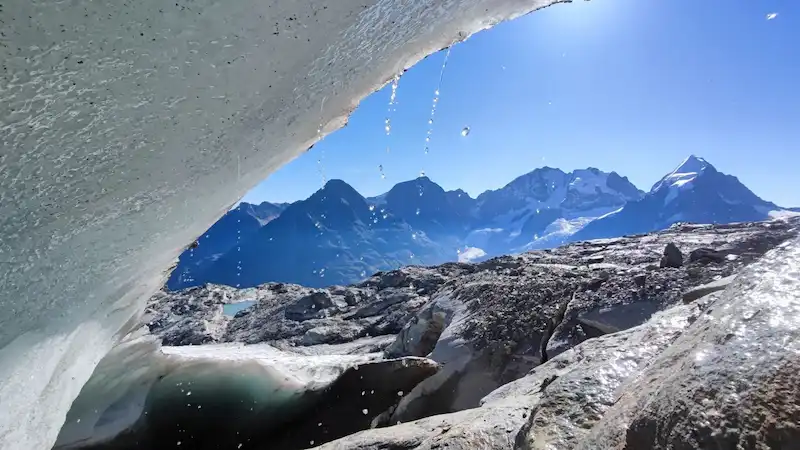


Glaciers in Switzerland are melting at an unprecedented rate, with a staggering 10% of their ice volume disappearing over just two years. This alarming trend is a result of a combination of low snowfall and rising temperatures, according to data released by the Swiss Commission for Cryosphere Observation.
In 2023 alone, Swiss glaciers lost 4% of their total volume, making it the second-highest level of melting recorded after the record-breaking year of 2022, which saw a loss of 6% of glaciers. To put this into perspective, the ice lost during these two years is equivalent to the ice lost over a three-decade period from 1960 to 1990.
Matthias Huss, head of the Swiss Glacier Monitoring Network (GLAMOS), described the recent losses as "mind-blowing" and unprecedented. He emphasized that while glaciers have been steadily losing mass for decades, the current acceleration is concerning and directly linked to climate change.
These extreme years have resulted in the collapse of glacier tongues and the disappearance of numerous small glaciers in the country. For instance, the St. Annafirn glacier in central Switzerland has shrunk to such an extent that monitoring it has been stopped.
The ice loss in these years has even been observed at higher altitudes, which typically do not experience such significant declines. GLAMOS reported the disappearance of several meters of ice in southern Valais and the Engadin valley, situated at altitudes of over 3,200 meters (10,500 feet).
The losses have been attributed to a winter with unusually low snowfall and a subsequent summer of exceptionally high temperatures. In February, snow levels reached a record low of around 30% of the long-term average. In June, a heatwave resulted in snow melting two to four weeks earlier than usual, further exacerbating the ice loss. The persistent high temperatures throughout the summer caused rapid melting of summer snowfalls.
The consequences of this significant glacier melt are profound. It is drastically reshaping the high-alpine landscape and creating hazardous conditions with unstable rocks and the increased risk of rockslides.
Moreover, the receding glaciers have led to somber discoveries. In July, the remains of a German mountain climber who went missing 37 years ago were found near a glacier close to Switzerland's famous Matterhorn.
While the water runoff from the melting glaciers has temporarily alleviated the severity of the country's drought and replenished hydropower reservoirs, this benefit is short-lived. As the glaciers continue to shrink, their crucial role in providing water during heatwaves will diminish, exacerbating water scarcity issues in the near future.
The long-term outlook for Switzerland's glaciers is alarming. Matthias Huss states that the glaciers in the Alps will continue to retreat and shrink, eventually only existing on the highest mountain peaks.
In June, Swiss voters approved a new law aimed at significantly reducing planet-heating pollution, influenced by climate groups demanding an end to fossil fuel consumption to save the glaciers. However, time is running out as climate change continues to accelerate. Recent research suggests that even if ambitious climate targets are met, up to half of the world's glaciers could disappear by the end of the century.