


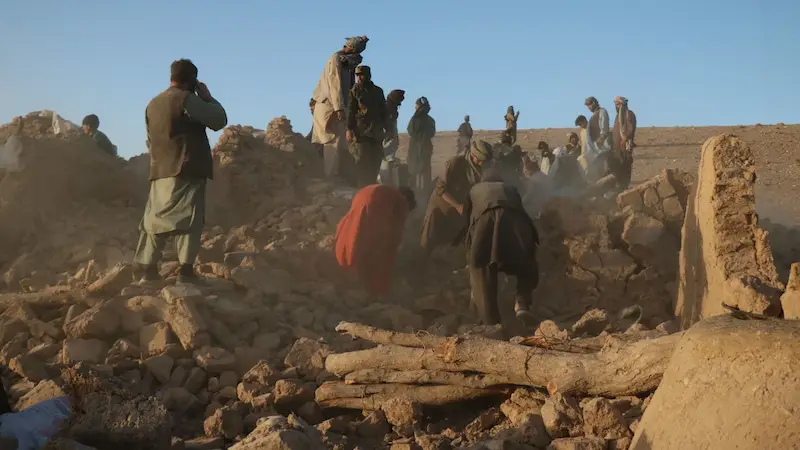


In a devastating blow to Afghanistan, a series of powerful earthquakes struck the country's western region, resulting in the loss of more than 2,000 lives and leaving over 9,000 people injured. This marked one of the deadliest tremors the quake-prone nation has experienced in years. The quakes, with the largest measuring a magnitude of 6.3, hit approximately 35 km northwest of Herat, according to the US Geological Survey.
The Ministry of Disasters spokesperson, Janan Sayeeq, provided a grim update on the situation, reporting that a total of 2,053 people had been killed and 9,240 injured. In addition, around 1,320 houses had been damaged or completely destroyed. These numbers sharply rose from the initial estimate of 500 deaths reported earlier by the Red Crescent. Rescue teams, numbering ten in total, were deployed to the affected area, which shares a border with Iran.
The influx of casualties overwhelmed local hospitals in the Herat province, where more than 200 bodies were brought for treatment. Women and children constituted the majority of the victims. Desperate to help those in need, the main hospital in Herat set up beds outside their facility to accommodate the flood of patients. The demand for essential supplies such as food, water, medicine, clothing, and tents became urgent, as highlighted by Suhail Shaheen, head of the Taliban political office in Qatar.
The medieval minarets in Herat suffered visible damage, as depicted in photographs circulating on social media, showing cracks and fallen tiles. Afghanistan, surrounded by mountains, has a history of enduring strong earthquakes, particularly in the rugged Hindu Kush region near the Pakistan border. The death toll from such natural disasters tends to rise as information trickles in from more remote areas. The country's fragile infrastructure, due to decades of conflict, compounds the difficulties involved in relief and rescue operations.
Afghanistan's healthcare system, predominantly dependent on foreign aid, has faced significant cuts since the Taliban's takeover, resulting in an economic downfall as international assistance diminished. Concerns about Taliban-imposed restrictions on women and other pressing global humanitarian crises have contributed to the reduction in financial support from donors. The Islamist government has prohibited most female aid workers from operating, although exceptions have been made for those involved in the health and education sectors.
The International Committee of the Red Cross recently announced it might withdraw its financial support for 25 Afghan hospitals due to funding limitations, raising uncertainty about the status of the hospital in Herat. The earthquake-induced panic sent residents fleeing onto the streets. A resident named Naseema reported the ongoing aftershocks and shared how people evacuated their homes in fear. With a total of 202 public health facilities in the Herat province, only one major regional hospital was equipped to handle the influx of more than 500 casualties, as reported by the World Health Organization (WHO).
The WHO also highlighted logistical challenges in remote areas, which hindered search and rescue operations and made it difficult to ascertain the full extent of the casualties in those regions. While relief efforts are ongoing, the situation remains grim and calls for immediate support to address the urgent needs of the affected population in Afghanistan.