


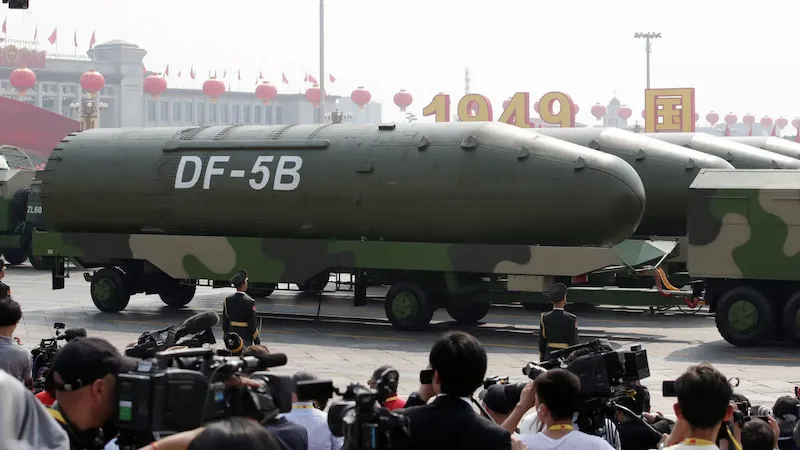


The Pentagon has released its annual report on China's military capabilities, revealing that China possesses over 500 operational nuclear warheads, surpassing previous estimates. The report also suggests that China may be exploring the development of conventionally-armed long-range missiles capable of reaching the United States. China's ongoing modernization of its military has allowed it to project power across the Pacific and enhance its capabilities in various domains of warfare, including land, air, sea, nuclear, cyber, and space.
Of particular concern is China's construction of three new fields of long-range ballistic missile silos, which provide additional options for deploying nuclear warheads from different platforms. A senior defense official expressed apprehension over China's lack of transparency regarding its nuclear buildup and urged China to engage in dialogue on strategic stability and risk reduction.
The report further reveals that China is utilizing advanced reactors and processing facilities to produce plutonium for its nuclear weapons program, contradicting its public claims that these technologies are solely for peaceful purposes. These findings underscore the complexity of China's military expansion and the need for greater transparency.
China's military capabilities have been identified as the "pacing challenge" in the US National Defense Strategy, positioning China as a significant competitor to the US in terms of military strength, economic power, and global influence. China currently boasts the world's largest navy, with the highest number of ships, as well as the largest air force in the region. Its military prowess allows China to assert sovereignty claims in the South China Sea and areas beyond, including Taiwan.
The Chinese military's aggressive actions towards Taiwan have intensified over the past year. These actions include ballistic missile overflights, incursions into Taiwan's airspace, and large-scale military exercises near the island. Despite Chinese President Xi Jinping's assertion of seeking peaceful unification with Taiwan, he has not ruled out the use of military force to achieve this goal.
China's aggression is not limited to Taiwan or its immediate neighbors. Chinese military pilots have engaged in "coercive and risky" behavior towards US aircraft over the East and South China Sea in recent years. These incidents have totaled over 180, with Chinese jets flying dangerously close to US military aircraft in an attempt to influence US operational activities.
US defense officials are frustrated by China's reluctance to engage in high-level military-to-military channels. However, there have been some interactions at the working level, such as a briefing on the unclassified summary of the US cyber strategy for the Chinese PLA defense attache. In addition, a meeting between Admiral Aquilino, INDOPACOM Commander, and a deputy chief of the PLA's Joint Staff Department took place in Fiji. The US emphasizes the importance of maintaining consistent open lines of communication across all levels, including the highest echelons of leadership.
The Pentagon's report sheds light on China's expanding long-range missile capabilities and nuclear arsenal, posing significant concerns for the US and its allies. It highlights the need for enhanced transparency, dialogue, and risk reduction measures to ensure stability in the region.