


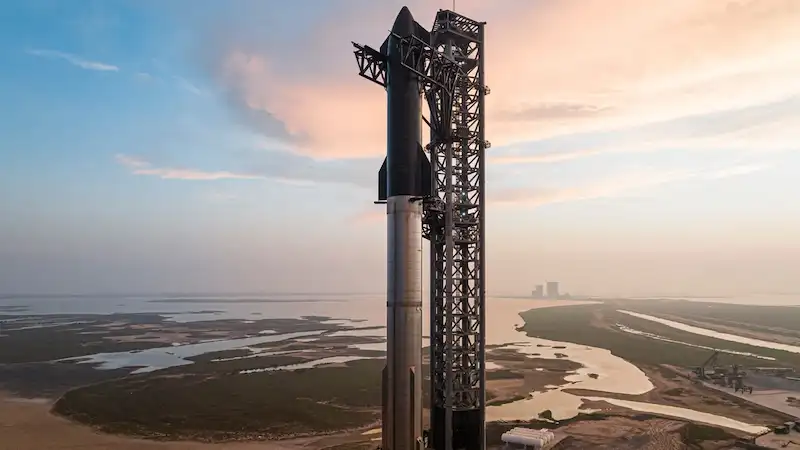


SpaceX is once again getting ready for the inaugural test flight of Starship, which is believed to be the most powerful rocket ever built. The successful launch of this vehicle could pave the way for future space missions, including the possibility of sending astronauts to Mars.
The launch is scheduled to take place on Thursday during a one-hour window that opens at 8:28 a.m. CT (9:28 a.m. ET). The rocket is already in position at SpaceX's private spaceport located on the southern tip of Texas.
This will be the second launch attempt for Starship after the first attempt on Monday was halted due to a problem with a valve that caused pressurization issues. Engineers decided to treat the remainder of the launch attempt as a "wet dress rehearsal". This practice run took the teams through all the steps for launch except liftoff.
Starship consists of two parts: the Super Heavy rocket booster, which is a 230-foot-tall cylinder that houses 33 engines and is expected to create a loud sound across the nearby coastal landscape as it fires up. The Starship spacecraft, which stands at 164 feet (50 meters) tall, rides atop the rocket.
The booster will ignite its engines and propel the spacecraft out over the Gulf of Mexico as it heads towards space. After about two and a half minutes, the Super Heavy rocket booster is expected to expend most of its fuel, separate from the Starship spacecraft, and fall into the ocean. The spacecraft will then use its own engines, which will burn for more than six minutes, to accelerate to almost orbital speeds or roughly 17,000 miles per hour.
Starship will complete almost one full lap of the planet and re-enter Earth's atmosphere near Hawaii. It is expected to splash down in the Pacific Ocean about an hour and a half after liftoff.
SpaceX CEO Elon Musk, who has a history of embracing the numerical reference to marijuana, has long had a penchant for the number 420. Last week, he even suggested that SpaceX's first launch attempt on Monday might be delayed to target a 4/20 liftoff. However, he has since sought to temper expectations for this test launch, saying that "success is not what should be expected...That would be insane."
The development of Starship has been based at SpaceX's Texas spaceport which is located 40 minutes outside Brownsville, on the US-Mexico border. Testing began years ago with brief "hop tests" of early spacecraft prototypes. The company started with short flights that lifted a few dozen feet off the ground before progressing to high-altitude flights, most of which resulted in dramatic explosions as the company attempted to land the prototypes upright.
One suborbital flight test in May 2021, however, ended in success. Starship's ultimate success or failure is immensely consequential, not only for SpaceX's future as a company, but also for the United States government's ambitions for human exploration of space.
While the stakes are high, SpaceX has a history of embracing mistakes and explosions in the name of refining its spacecraft design. In the lead-up to the first launch of the company's Falcon Heavy rocket, which held the title of the most powerful rocket before NASA's Space Launch System took flight last year, Musk foresaw only a 50-50 chance of success. The inaugural Falcon Heavy launch in 2018 was ultimately successful.
It's common for first-time launches to be delayed as engineers work through issues that may not have been apparent during prior testing. NASA's SLS rocket, for example, underwent four attempts to complete a wet dress rehearsal and two launch attempts before the vehicle finally took off in November 2022.