


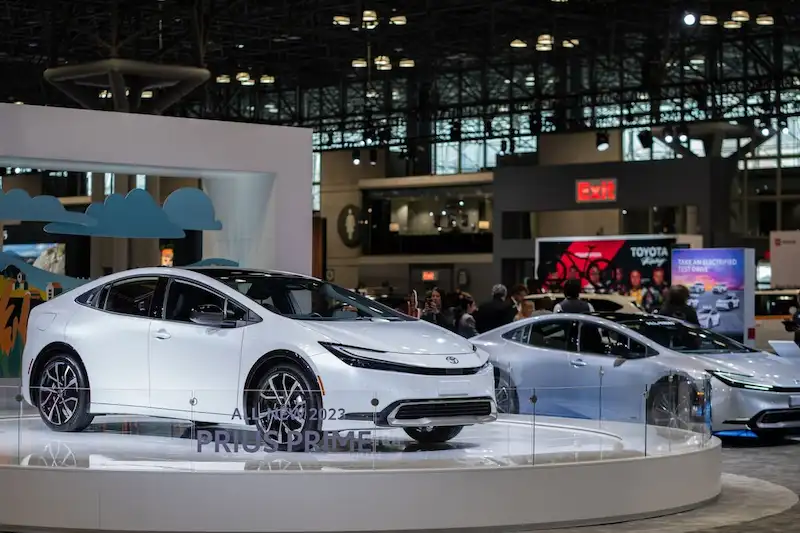


Hybrid vehicles are experiencing record-breaking sales in Japan, surpassing traditional gasoline and diesel cars for the first time in 2023 and set to exceed half of domestic passenger vehicle sales by next year, according to Bloomberg Intelligence. This trend follows the release of Toyota's groundbreaking Prius, the world's first mass-produced hybrid vehicle, back in 1997. While other developed markets are pressuring manufacturers to transition to fully electric vehicles (EVs), Japanese carmakers have been more hesitant to make the shift, but have recently committed to introducing a wider range of battery-only models in the next few years.
One of the primary reasons for the popularity of hybrids in Japan is their affordability and reliability. Unlike EVs, hybrids do not rely heavily on robust charging infrastructure, making them a practical choice for Japanese drivers. Additionally, the relatively high prices of imported EVs, such as Tesla's Model 3 sedan, compared to the more affordable Toyota Prius, have dampened enthusiasm for EV adoption. Limited charging infrastructure and concerns about range anxiety further contribute to the preference for hybrids among Japanese drivers, especially in the absence of a strong charging network.
In 2022, new passenger car sales in Japan, including the lightweight "kei" category, consisted of 51% gasoline vehicles, 43% hybrids, 4% diesel models, and only 2% battery-electric vehicles, according to Bloomberg Intelligence. Analyst Tatsuo Yoshida predicts that hybrids will continue to gain market share beyond 2024 as gasoline vehicles continue to decline, and EVs gain momentum, potentially reaching double-digit market share by 2030. Yoshida estimates that hybrids will account for two-thirds of sales by the end of the decade.
While the Toyota Prius remains one of the most iconic hybrid models, Japanese automakers offer several other popular hybrids, including the RAV4 SUV and Camry sedan from Toyota, as well as Honda's Accord, Volkswagen's Golf GTE, and Hyundai's Elantra Hybrid. However, Japanese car manufacturers are not without EV ambitions. Toyota aims to sell 1.5 million battery-electric vehicles annually by 2026 and 3.5 million by 2030. Honda plans to produce at least 2 million EVs in 2030 and aims for EVs and hydrogen fuel cell cars to constitute all sales by 2040. Nissan predicts that EVs and hybrids combined will account for 44% of global sales by 2026 and 55% by 2030.
While these targets primarily involve exports to the US, Europe, and China, where EV adoption has been more rapid, Japan's carmakers acknowledge the growing importance of EVs both domestically and globally. Toyota, in particular, has faced criticism for its slower pace in ramping up EV sales compared to environmental advocates' expectations. Recently, consumer groups accused the company of misleading customers by using terms like "electric" and "electrified" for vehicles that still rely on combustion engines, including hybrids. However, Toyota maintains a "multi-pathway" approach, providing customers with various powertrain options, as the company believes a complete shift to EVs is not yet realistic.
Despite some skepticism, Toyota, as the world's largest carmaker, recognizes the increasing role that EVs will play in achieving carbon neutrality. The Japan Automobile Manufacturer’s Association stated the necessity of nurturing the EV market in Japan, acknowledging that while EVs are not the sole path to carbon neutrality, they will become a significant force in the global economy. Therefore, Japanese automakers are committed to embracing the changing landscape of the automotive industry and meeting the evolving demands of consumers worldwide.