


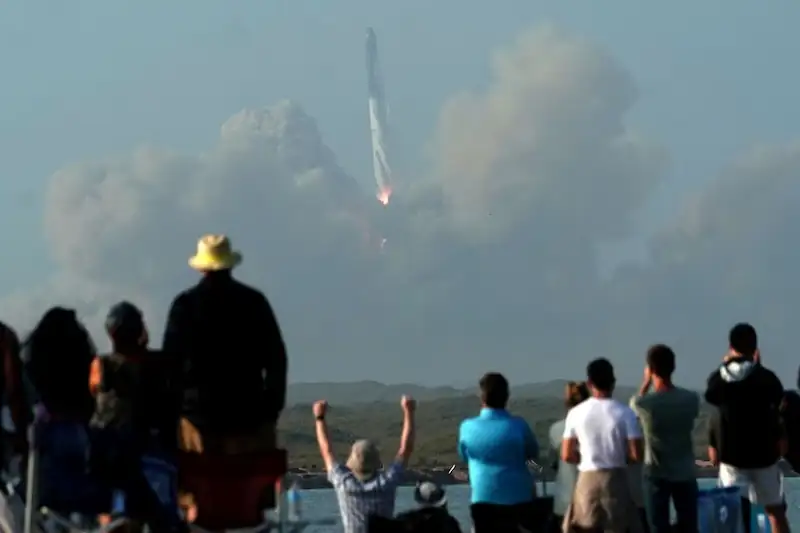


SpaceX has suffered a setback in its ambitious plan to eventually send humans to the moon and Mars, as the company's next-generation Starship spacecraft exploded just minutes after liftoff from South Texas. The test flight was the first for Starship mounted atop the company's new Super Heavy rocket booster, which SpaceX has touted as the world's most powerful rocket vessel. Even though the two-stage rocket ship failed to make it beyond an altitude of 23 miles (37 km), the flight achieved a primary objective of getting the new spacecraft off the ground in an otherwise seemingly clean liftoff.
The plan was to deploy Starship into space and have it reenter Earth's atmosphere 60 miles (97 km) off a Hawaiian coast before plunging into the Pacific. But the explosion cut the mission short. SpaceX officials, however, were heartened by the outcome and hailed the feat of getting the Starship and booster rocket off the launch pad for the first time, declaring the brief episode in that sense to be a successful test flight.
The two-stage rocket ship, standing taller than the Statue of Liberty at 394 feet (120 meters) high, blasted off from the company's Starbase spaceport east of Brownsville, Texas. SpaceX hoped, at best, to pull off a 90-minute debut flight into space but just shy of Earth orbit.
While SpaceX officials were heartened by the outcome, the mission fell short of reaching several of its objectives. It was not immediately clear whether the explosion was caused by the spacecraft's automated flight-termination system, which is triggered onboard when the rocket begins to show signs of failure. Nevertheless, SpaceX principal integration engineer John Insprucker, serving as one of the webcast commentators, said the test flight would provide a wealth of important data paving the way for the company to move ahead with additional tests.
Elon Musk, SpaceX's founder, chief executive, and chief engineer, had appeared eager to temper expectations in remarks made Sunday that downplayed the odds of a successful first flight. Musk said on Twitter that the next Starship test launch would be in a few months, and a number of additional Super Heavy boosters are already on deck in Boca Chica, Texas, for future test flights.
The road to Thursday's accident has not been without previous tests and setbacks. Before this, SpaceX had test-launched prototypes of Starship's top half in five subspace flights to an altitude of 6 miles (9.7 km), seeking to perfect its return landing capability. All but one of those crashed in flames. The spectacular nature of Thursday's loss of the first fully integrated Starship-and-booster vehicle during its introductory launch further highlighted challenges SpaceX faces moving beyond its workhorse Falcon 9 rocket, the centerpiece of the company's satellite launch business.
Despite the setback, NASA chief Bill Nelson congratulated SpaceX on the Starship's first integrated flight test, saying, "Every great achievement throughout history has demanded some level of calculated risk because with great risk comes great reward. Looking forward to all that SpaceX learns, to the next flight test — and beyond."