


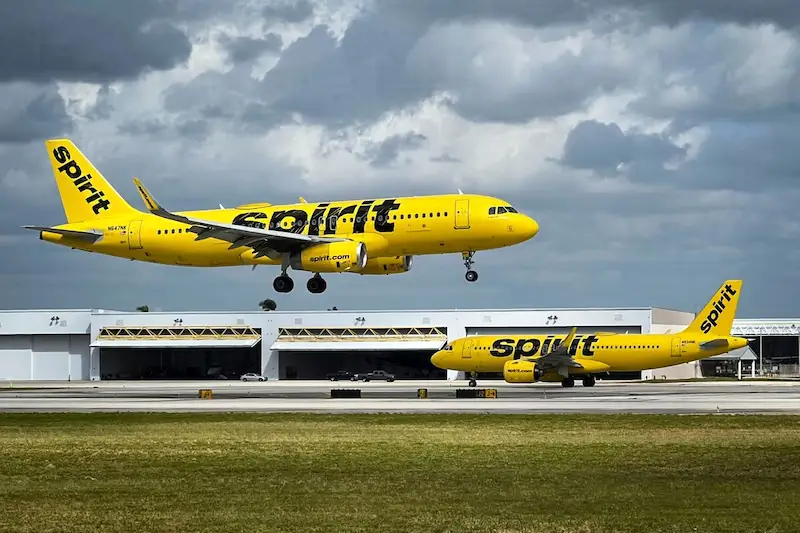


In a bid to safeguard their investments amidst growing concerns about Spirit Airlines Inc.'s ability to manage its substantial debt load exceeding $3 billion, bondholders are devising a unique strategy known as the "triple-dip." This plan seeks to mitigate potential losses by leveraging a series of financial maneuvers carried out during a 2020 bond offering. The issuance involved certain units of the company issuing notes backed by Spirit's loyalty program and intellectual property, with the proceeds funneled to the airline's parent company, which provided a guarantee for the debt.
Referred to as a "triple-dip" by industry insiders, this approach echoes the structure of a "double-dip" commonly used by distressed companies seeking additional financing by offering lenders multiple claims on their assets. The bondholders involved in the Spirit Airlines situation assert that they hold three distinct claims - one against Spirit's guarantee, another against the intercompany loan, and a third against the loyalty program and associated assets.
While the concept of a "triple-dip" has not been litigated in court, its predecessor, the "double-dip," has proven effective in previous bankruptcy cases. Notably, creditors with claims tied to both American Airlines and its parent company received full payouts when AMR Corp. emerged from bankruptcy protection in 2013. Building on this precedent, the bondholders are exploring ways to strengthen their claims on the collateral, potentially improving their recovery prospects.
Despite these proactive measures, uncertainties remain for the bondholders in the event of a potential bankruptcy filing by Spirit Airlines. While the "triple-dip" strategy could enhance their position relative to other creditors, such as aircraft lessors and convertible bondholders, the ultimate outcome in a restructuring scenario is still subject to various factors. Spirit Airlines, for its part, has expressed confidence in its operational strengths and profitability prospects, signaling a commitment to explore options for refinancing its upcoming debt maturities.
Currently, Spirit's 8% loyalty bonds are trading at around 72.625 cents on the dollar, offering a yield exceeding 30%, according to market data. As the airline navigates its debt obligations and engages with creditors, the implementation of the "triple-dip" strategy underscores the complex dynamics at play in the distressed debt landscape and the strategic maneuvers employed by stakeholders to protect their interests in challenging times.