


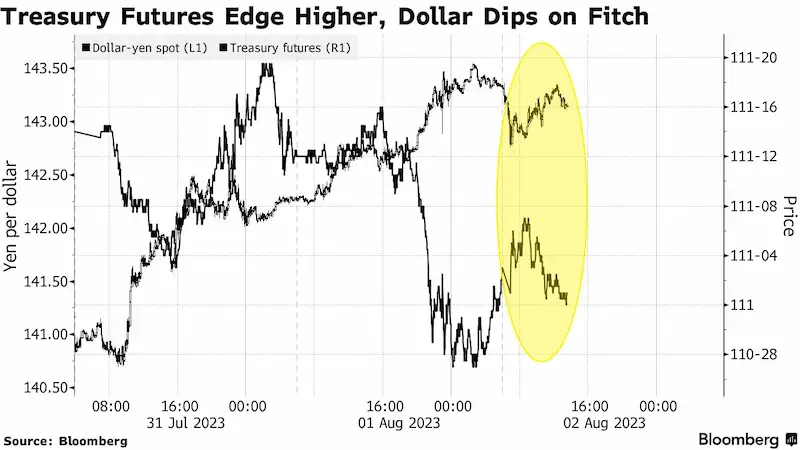


Fitch Ratings' recent downgrade of the US government debt has sparked criticism and raised concerns about the country's fiscal situation. The downgrade comes amidst fears that the growing fiscal deficits could eventually lead to market turbulence, impact the economy, and even influence the outcome of the upcoming presidential election.
Fitch downgraded the US sovereign credit rating from AAA to AA+, just two months after warning that the rating was at risk due to lawmakers' battles over raising the nation's debt limit. Fitch justified the downgrade by stating that the country's finances are likely to deteriorate over the next few years, citing tax cuts, new spending initiatives, economic shocks, and repetitive political gridlock as contributing factors.
Shortly before the US Treasury Department plans to increase borrowing to address the growing budget deficit, Treasury Secretary Janet Yellen criticized the downgrade as "arbitrary" and "outdated." Yellen pointed out that the economy has recently shown signs of resilience, and the debt limit issue was eventually resolved.
Despite the downgrade, the bond market appeared largely unaffected. The yield on 10-year Treasuries remained stable, while rates on German securities experienced only slight declines. However, risk-sensitive assets took a hit, with Europe's Stoxx 600 Index experiencing its largest decline in a month, and US futures indicating potential losses at the market open.
Fitch's downgrade mirrors a similar action taken by S&P Global Ratings in 2011, which was never reversed. While most investors still view US Treasuries as the safest haven and reliable collateral, the downgrade puts a spotlight on the deteriorating US fiscal outlook.
Laura Cooper, senior investment strategist at BlackRock International, suggested that although investors may briefly consider the high levels of public debt, they are likely to dismiss it as a medium-term concern. However, Cooper believes that eventually fiscal challenges will become more relevant to market participants, leading to a higher term premium on US Treasuries.
The US federal deficit has reached $1.39 trillion for the first nine months of the current fiscal year, representing a 170% increase from the previous year. The Treasury has adjusted its borrowing forecast for the current quarter to $1 trillion, significantly higher than the $733 billion predicted in May.
These numbers contributed to a rise in the yield on 30-year US debt to the highest level in nearly nine months before Fitch announced the downgrade. The US Treasury will disclose its quarterly financing plans, which are expected to address the growing budget deficit, on Wednesday.
Fitch's downgrade has sparked renewed political debate, which is likely to continue leading up to the November 2024 election. Democrats in Congress have blamed Republicans for obstructing the debt ceiling increase earlier this year, while Republicans have attributed the situation to President Joe Biden's spending agenda, known as "Bidenomics." Fitch had previously warned about the possibility of a credit rating downgrade back in May when lawmakers were at odds over raising the borrowing limit, and the Treasury was approaching a cash shortage.
In addition to the fiscal management concerns, Fitch also highlighted the rapid increase in the country's debt burden. It projects the debt-to-GDP ratio to reach 118% by 2025, more than double the AAA median of 39.3%. The rating agency warns that a further increase in the debt-to-GDP ratio will make the US more susceptible to future economic shocks.
When S&P downgraded the US credit rating more than a decade ago, it triggered a broad sell-off in equities but paradoxically boosted demand for Treasuries as investors sought out safe havens. The impact of Fitch's downgrade is uncertain, with some speculating that it could tarnish the US's reputation, while others suggest that it may lead to increased safe haven buying of US Treasuries and the dollar.
With Fitch's downgrade, the US now holds two AA+ ratings. This poses an issue for funds or index trackers that have a mandate to invest only in AAA-rated assets, potentially resulting in forced sales for compliance purposes. Moody's Investors Service still rates the US sovereign debt as Aaa, the highest grade.