


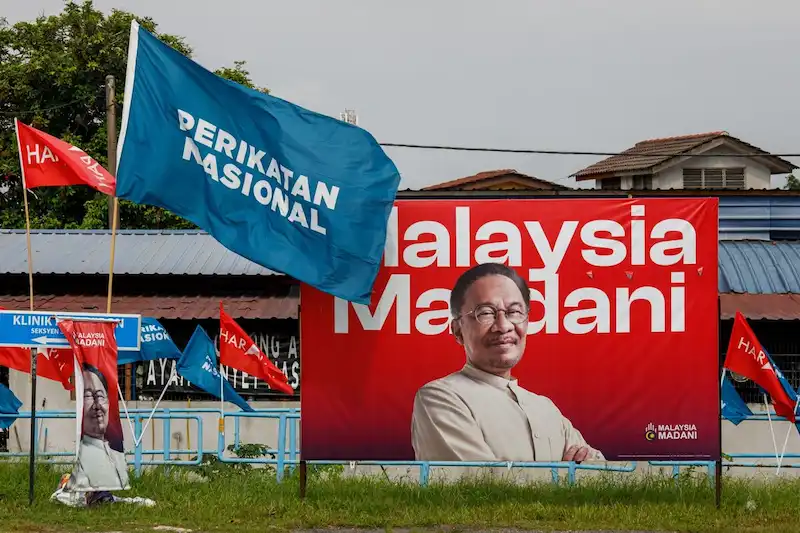


Political leaders in the largest Muslim-majority countries in Southeast Asia are facing a growing challenge from religious conservatism, as recent events in Malaysia have demonstrated. In provincial elections held last week, far-right Islamist groups made significant gains in three out of six states. While Prime Minister Anwar Ibrahim's multi-cultural coalition managed to retain control of the three states it formerly held, it saw Islamists snatch more seats in Selangor, the wealthiest state still under its rule.
This shift towards conservatism is reflective of a larger trend affecting the region, where decades of economic growth have been abruptly halted by the pandemic and a global economic slowdown. In neighboring Indonesia, President Joko Widodo's government has had to make political concessions to religious conservatives, who are gaining influence in the world's most populous Muslim nation.
For instance, in July, Indonesia's Supreme Court effectively ended the state recognition of inter-faith marriages due to pressure from conservatives. And last December, the country passed a comprehensive law that criminalized extramarital sex, among other things, highlighting the increasing power of conservatives to shape state policies. President Jokowi's decision to appoint a top Islamic cleric as his vice president in 2019 also raised concerns among progressives about the potential impact on policy.
The rise of conservative politics in both Malaysia and Indonesia presents a dilemma for leaders like Anwar and Jokowi. As conservative voices gain prominence, governments face increasing pressure to emphasize their religious credentials, potentially at the expense of economic policies that drive business and investment.
In Malaysia, the trend towards conservatism is driven in large part by young voters who are drawn to the idea of faith-based politics. These voters view leaders like Muhyiddin, Anwar's rival, as more Islamic and better equipped to lead the country. Muhyiddin's aid initiatives during the pandemic have solidified this perception for many young Malaysians.
However, embracing conservative policies comes with economic risks for these nations, particularly when it comes to attracting foreign direct investment (FDI). Investors are increasingly paying attention to environmental, social, and governance (ESG) issues, and countries that implement draconian social policies risk deterring investment. Companies operating in these regions need to be mindful of the societal trends and potential regulatory requirements that could impact consumer behavior.
Religious education plays a significant role in shaping conservative views in Malaysia and Indonesia. Both countries have a network of Islamic preschools that have contributed to the growth of religious conservatism among the younger generation. Additionally, the failure of national education systems in these countries has led to a reliance on religious schools, further reinforcing conservative ideologies.
The challenge for leaders like Anwar is countering the simplistic messaging of conservative parties, particularly the notion that Islam is under threat and elections are a battleground for Muslims to defend their faith. This messaging, rooted in a 15th-century mindset, resonates with many voters but hampers efforts to promote progressive policies and nation-building.
Both Malaysian and Indonesian leaders have cautioned against granting too much power to religious-focused political parties. President Jokowi has consistently spoken out against "identity politics," emphasizing the importance of inclusive governance. Prime Minister Anwar, on the other hand, has authorized the arrest of individuals who exploit religion and race to incite dissent.
Finding a balance between religious considerations and progressive policies will be crucial for the leaders of Malaysia and Indonesia. Successfully navigating this challenge will not only impact the political landscape but also determine whether these countries can continue to attract investment and drive economic growth in the post-pandemic era.