


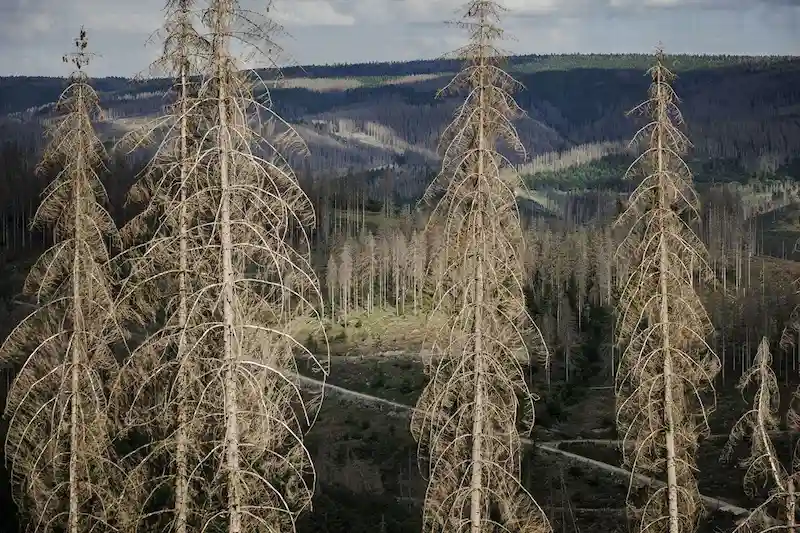


In the vast forests surrounding Augsburg, Bavaria, Eva Ritter stands among the remnants of dead spruce trees, filled with concern. These trees, once vital in absorbing emissions and combating climate change, have fallen victim to a destructive infestation of bark beetles. Due to years of drought weakening their defenses, the beetles were able to penetrate the trees and wreak havoc on their insides, leaving Ritter and her team of foresters no choice but to have them cut down before the damage spreads. The magnitude of the destruction weighs heavily on Ritter, who is responsible for overseeing thousands of hectares of woodlands near Augsburg, an area renowned for its abundant timber stocks. She remarks, "In our business, climate change is part of everyday life."
While wildfires have dominated recent headlines, the devastation caused by bark beetles is a less conspicuous threat to Europe's forests. Nevertheless, it is an integral component of the growing challenges that undermine the continent's efforts to tackle climate change. The European Union aims to achieve climate neutrality by 2050, requiring not only a reduction in emissions but also an increase in removing carbon dioxide from the atmosphere. As part of this strategy, the EU plans to plant 3 billion additional trees by 2030. However, preserving existing trees has proven to be an arduous task.
This summer, Greece experienced devastating wildfires that destroyed an area larger than New York City, claiming the lives of at least 25 individuals. In Germany, bark beetles, drought, and storms led to record rates of forest destruction last year. Austria witnessed a near-doubling of bark beetle damage in 2022, while the Czech Republic has been plagued by severe outbreaks since 2018, resulting in forests actually increasing carbon emissions due to rotting trees.
While fires receive significant media attention, Gert-Jan Nabuurs, a professor of European forest resources, stresses that Central European droughts and bark beetle infestations are the primary concerns. In Germany, even weeks of rainfall have failed to alleviate the forest's thirst. Precipitation during the summer is quickly absorbed or evaporated, while wet and snowy winters, crucial for sustained soil moisture, have become increasingly scarce. Data from the Helmholtz Center for Environmental Research indicates that large portions of Germany have experienced drought since 2018.
For the weakened trees, bark beetles find it easier to penetrate and lay eggs beneath the bark. The larvae then feed on the vital bark layer responsible for nutrient transportation. Infested trees must be felled and removed within weeks to prevent the insects from spreading further. Spruce trees are particularly susceptible to bark beetles, and their widespread cultivation in Germany after World War II has made them a quarter of the country's woodlands. However, their shallow roots necessitate a significant amount of water, making them vulnerable to wind and storm damage and drying out the soil for other vegetation.
There have been ongoing efforts in Germany over the past few decades to establish more natural, mixed forests consisting of various conifers and deciduous trees to enhance resilience. However, progress has been slow due to several factors, including the fact that around half of German woodlands are privately owned. Each year, approximately 65,000 individuals inherit a forest, many lacking the necessary skills, experience, and resources to manage damage and outbreaks. Moreover, a 2018 survey by the Thünen Institute revealed that nearly 40% of private owners prioritize economic uses over preservation, despite recognizing the crucial role of forests in climate protection.
While forests have traditionally been a source of raw materials, biomass, including wood burning, remains the primary source of renewable energy in the EU, accounting for nearly 60% of the share. Critics argue that although trees can regrow, excessive wood harvesting destroys a finite resource and leads to higher emissions. Andreas Bolte, director of forest ecosystems at the Thünen Institute, emphasizes the need to avoid burning wood that could be used for more valuable purposes, acknowledging the necessity of some energy production from wood while advocating for responsible usage.
Europe's forests are expected to experience a worsening of their carbon-absorbing capabilities in the coming decade, primarily due to increased damage and timber harvesting. However, Michael Köhl, a professor of world forestry, asserts that forests should not be viewed solely as passive carbon sinks. By utilizing wood as an alternative to more emissions-intensive materials like cement, forests can contribute to pollution reduction through substitution.
Future-proofing forests is a complex endeavor, with differing viewpoints on how best to accomplish it. Some argue for a hands-off approach, allowing natural destruction to pave the way for biodiversity to return. Others advocate for active support in reforestation efforts, cultivating tree species better suited for warmer climates. Ritter has been experimenting with varieties from milder parts of Germany, as well as trees native to Turkey and the Balkans, such as the Turkish hazel. She remarks, "We need trees that can thrive in both refrigerators and ovens."
Forestry work has become increasingly challenging to plan, with crisis mode being the new norm. Daniel Kugler, a forest section manager near Augsburg, reflects on the changing landscape, stating, "For the past few years, we have been permanently in crisis mode." His words resonate as he stands among the wreckage of a recent storm that narrowly missed toppling a tree onto a water pump. The struggle to protect and preserve Europe's forests in the face of multiple threats is a continuous battle.