




Delhi, India's capital, has been grappling with severe air pollution during winter for the past decade. The pollution, consisting of toxic particles from car emissions, industrial sources, and agricultural residue burning, becomes trapped in the city and surrounding areas when temperatures drop and wind speeds decrease. This hazardous situation particularly affects the health of vulnerable groups such as children and the elderly.
In an effort to combat this recurring problem, Delhi authorities have once again implemented emergency measures like reducing road traffic, banning farm fires, and activating the city's smog towers to improve air quality. However, this has sparked a renewed debate on the effectiveness of these towers.
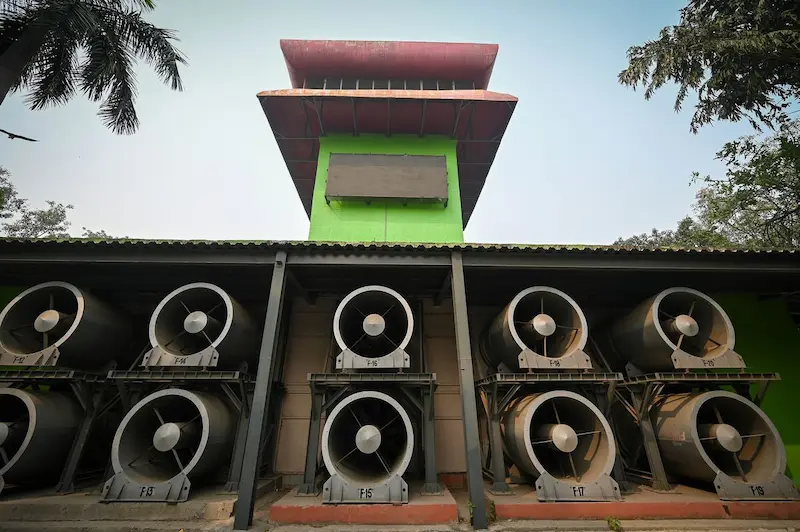
Smog towers are essentially giant air purifiers that rely on the same principles as the small fans connected to high-efficiency particulate air (HEPA) filters used in many households. These towers, often standing as tall as twenty meters, are equipped with thousands of filters and are designed to capture pollution particles and enhance air quality, particularly in densely populated areas. While the technology behind smog towers is relatively straightforward, they require substantial maintenance and come with a steep installation cost. For instance, the smog tower installed in Connaught Place, a prominent business center in Delhi, cost around $2.5 million in 2021.
The concept of smog towers in India stemmed from a similar initiative in the city of Xi An, China. The Indian government was urged by the country's high court to install smog towers in Delhi to curb air pollution, with financial support from private companies and technical assistance from researchers at the Indian Institute of Technology Bombay.
In Delhi, there are at least two main smog tower units that are activated when air quality deteriorates. However, the effectiveness of these towers in significantly improving air quality remains in question. Due to their outdoor operation, smog towers struggle to clean a sufficient volume of air within a short timeframe. The filtered air quickly mixes with the surrounding pollution, negating any noticeable improvements.
A recent study conducted by researchers at the Indian Institute of Technology Bombay focused on the smog tower in Connaught Place. They found that the tower cleans air with approximately 50% efficiency, which diminishes to 30% at a distance of 50 meters from the filters and drops to just above 10% when 500 meters away. Additionally, the researchers discovered that the structure holding the filters in place was not tightly sealed, allowing polluted air to bypass the filtration system.
While local authorities in Delhi and other regions continue to support the idea of smog towers, the prevailing scientific consensus is that they are both expensive and ineffective at significantly improving air quality. The operation of smog towers would require an exorbitant number of filters to effectively clean Delhi's air, estimated to cost over $20 billion—more than 2.5 times the entire Delhi state budget for a given year.
In conclusion, smog towers have garnered attention as a potential solution to Delhi's chronic air pollution. However, the limitations of their outdoor operation, cost-intensive implementation, and their inability to clean air efficiently over larger distances have led many experts to question their efficacy. As discussions on finding more comprehensive and sustainable solutions continue, the focus remains on addressing the root causes of air pollution and implementing measures that can make a substantial and lasting impact on the air quality in Delhi and other affected areas.