


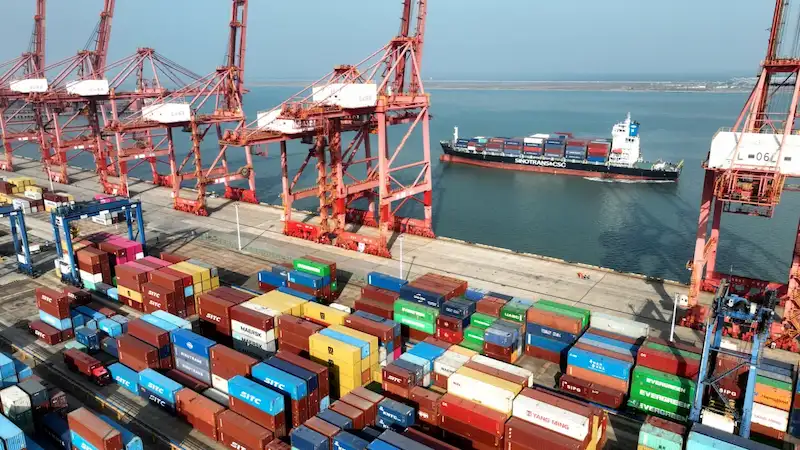


China's economy experienced a difficult year in 2023, with the outlook for 2024 not looking much better. The country's exports, excluding cars, saw their first annual decline since 2016 as global demand for Chinese-made goods weakened. Chinese officials expressed concerns that shaking off this slump in 2024 will be a challenging task.
In addition to the decline in exports, China is also grappling with deflationary pressures. Consumer price inflation in 2023 reached its lowest level in 14 years. The consumer price index for December showed a slight improvement compared to November, but still recorded a 0.3% decline compared to the same period in 2022. Throughout 2023, prices only increased by 0.2% over the previous year, marking the weakest reading since the global recession in 2009.
China is facing a double blow from weakened demand both domestically and abroad. In 2023, exports measured in US dollar terms amounted to $3.38 trillion, a 4.6% decline compared to the previous year. This is in stark contrast to the 7% increase in Chinese exports witnessed in 2022. The last time China experienced a decline in overseas shipments was in 2016 when exports fell by 7.7%.
Imports also experienced a decline in 2023, dropping by 5.5% to $2.56 trillion. As a result, China ended the year with a trade surplus of $823 billion, reflecting the struggles faced by the world's second-largest economy.
Lyu Daliang, a spokesperson for the General Administration of Customs, attributed the decline in exports to sluggish global economic recovery and weak external demand. He highlighted the ongoing challenges China faces on export markets due to persistent weakness in global demand and the hindering effects of protectionism and unilateralism.
The consumer inflation gauge in China has consistently fallen year-on-year for three consecutive months, representing the longest streak of declines since 2009. The price of food, particularly pork, had a significant negative impact on inflation rates.
Goldman Sachs analysts pointed out that the low core CPI inflation is indicative of dampened domestic demand resulting from the ongoing property downturn and a stressed labor market. Meanwhile, factory-gate prices measured by the Producer Price Index (PPI) also remained subdued. The PPI dropped by 2.7% in December compared to the same period in 2022, making it the 15th consecutive month of decline. Throughout 2023, the PPI fell by 0.3%.
Looking ahead, analysts from Capital Economics anticipate a slight increase in core inflation supported by a cyclical recovery in China's economy. However, deflationary pressures are expected to persist due to weak global growth and ongoing over-investment in China.
Despite the gloomy data, there were some encouraging signs. In December, exports showed a 2.3% growth compared to the same period in the previous year, indicating a slight improvement in the global demand for Chinese goods. Prior to November, Chinese exports had experienced a decline for six consecutive months.
China's trade with Russia reached a record high in 2023, totaling $240 billion, representing a 26% increase from the previous year. This accounted for 4% of China's total trade. The United States remains China's largest single-country trading partner, although the percentage of total trade dropped in 2023 compared to the previous year. The Association of Southeast Asian Nations (ASEAN) and the European Union contributed significantly to China's total trade.
The automobile sector showed promise with a 69% surge in total automobile exports, making it the highest growth category. China shipped 5.22 million vehicles in 2023, a 57% increase from 2022. This growth can be attributed partially to the rising demand for electric vehicles. China's General Administration of Customs noted that one out of every three cars exported from China is an electric passenger vehicle. They expressed confidence in the country's comprehensive competitive advantage in the auto industry and its ability to continue providing innovative products to meet global consumer demands.
As China navigates the challenges posed by weakening exports and ongoing deflationary pressures, the country remains hopeful for a steady recovery in its economy, focusing on areas with potential for growth and innovation.