


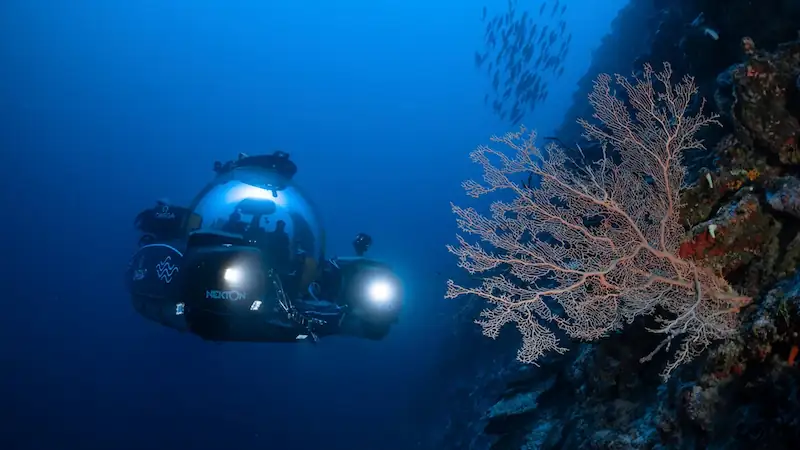


A global initiative has been launched with the aim of discovering and documenting marine life that has remained hidden in the depths of the world's oceans. The Ocean Census project is a ten-year effort to identify more than 100,000 unknown species, which will enable scientists to gain a better understanding of the deep-sea ecosystem and help protect it.
There are still many gaps in our knowledge of the ocean depths. Although it is believed that there are 2.2 million species in the Earth's oceans, only 240,000 have been described by scientists, according to the census. The initiative builds on past projects such as the Census of Marine Life, which concluded in 2010 and identified 6,000 potential new ocean species.
New technological advances include high-resolution underwater imaging, machine learning, and sequencing of DNA contained in seawater, which will help accelerate the speed and scale of discovery of new life-forms. These innovations are expected to make it much easier for sea creatures to be studied in their natural habitat. Tools like underwater laser scanning can scan gelatinous creatures such as jellyfish that are difficult to study on land. Additionally, new and accessible techniques to sample waterborne DNA to detect and track species will also be utilized.
Marine biologist Alex Rogers, the project's science director and a professor of conservation biology at the University of Oxford in the UK, hopes that the project will lead to incredible scientific discoveries over the next decade, including the discovery of completely new ecosystems. He noted that while many of the species discovered are likely to be on the smaller side, the world's longest sea creature was only discovered in 2020 off the coast of Western Australia - a 150-foot stringlike animal known as a siphonophore.
The Ocean Census project will also help to identify how marine ecosystems are responding to the climate crisis and assess how marine life could adapt to a warmer climate. The project is being led by Nekton, a UK-based marine science and conservation institute, and funded by The Nippon Foundation, a nonprofit foundation based in Japan.
Dozens of expeditions to the ocean's biodiversity hotspots will search for new species involving divers, submarines, and deep-sea robots. The project also hopes to involve private vessels and individuals. The data and information gathered will be openly accessible for scientists, policymakers, and the public for non-commercial use.